Mirliton How-To Tips
Search tips by keyword:

Want to Grow a Mirliton Without Heatwaves or Anthracnose?
Tired of heat and disease killing your vine? Here are two simple ways to grow them in cool, disease-free weather — and get a crop.
(1). Plant your sprout in the fall, then heavily mulch it for the winter. When it pops up the next spring, it will flower and fruit. We’ve seen this work.
(2). Plant the sprout in the fall in a 3-gallon container and overwinter it in a window. You can safely prune it back all winter. Then, transplant it into the ground the first week of March. I guarantee it will flower and produce a small crop in the spring. We’ve learned this from past experience.
More information on overwintering mirlitons in containers is available here.
We Have Changed the Two Categories of Certified Mirlitons
 We Have Changed the Two Categories of Certified Mirlitons
Leave the Leaves: Why You Shouldn’t Remove Anthracnose-Infected Leaves

Summary:
The standard advice we hear is to remove diseased leaves and stems to reduce the spread of anthracnose and other fungal diseases. It’s wrong; in fact, rummaging around in a mirliton vine, pinching off or clipping infected leaves will increase the spread of the disease. That’s because plant diseases are dispersed differently, depending on the disease and the plant. Anthracnose spreads differently from other fungi. And mirlitons, unlike pepper or bean plants, are dense, climbing vines that you can’t prune without rubbing up against the leaves. Those leaves can look perfectly healthy, but be covered with fungal toxins and their spores. When you brush up against them, you become a human transport of the deadly sticky anthracnose spores.
Your vine is better off left alone.
Here’s the Science:
Rummaging around in your Mirliton vine to prune off infected leaves probably spreads the disease even more. Anthracnose pathogens (Colletotrichum spp.) produce conidia (spores) in slimy, mucilaginous masses that are specifically adapted for water-splash dispersal, not wind. That sticky mucilage matters here: the spores are sticky and suspended in a wet matrix, which is exactly what makes them transferable by contact. When you push through a dense, wet vine, you are doing what a rain splash does — picking up conidia on hands, sleeves, and tools and depositing them on healthy tissue and at fresh wounds
This is well established for Colletotrichum in general and is why the standard advice across many crops is to avoid working plantings when foliage is wet. That’s nearly impossible along the Gulf Coast, where morning dew and daily afternoon coastal showers keep the vines moist — as well as the sweat-soaked clothes you wear while gardening.
Moreover, even if most of your vine looks healthy, those healthy-looking leaves can be covered with anthracnose fungi and their spores. The pathogens and their sticky spores can be on the leaves long before any visible symptoms, such as brown or yellowing spots or stem lesions, appear. Which means while you are brushing up against what appear to be healthy leaves to get what are clearly infected ones. You are spreading more disease to the healthy leaves than you accomplish by removing the clearly infected ones. This is why we constantly advise growers not to remove dead leaves–even when there are no signs of disease. You get a pretty vine, at the risk of spreading diseases!
There have been numerous scientific studies on human-borne spore transport.
In one study on bean anthracnose (Colletotrichum lindemuthianum), workers and equipment moving through wet fields were identified as a significant dispersal route, and the standard recommendation became to stay out of bean fields when foliage is wet. There’s comparable documentation for strawberry anthracnose (C. acutatum), where workers’ hands, clothing, pruning tools, and picking activity have been shown experimentally to move conidia from plant to plant during harvest. They tested transmission on denim, leather, metal, and rubber (i.e., clothing and equipment surfaces) using prepared spore inoculum in both wet and dry crop canopies, and found that equipment and workers transmit pathogens from infected to clean plants.
So, both science and plain common sense tell us:
Leave the leaves if you don’t want more disease!
Elevated Raised Beds
If excessive rainfall is chronically flooding your mirliton bed, consider building a large, deep, elevated raised bed with bottom and lateral drainage. You can still do a ground planting, but place the elevated raised bed under the same trellis and shade cloth structure to provide you with a backup vine.
It doesn’t have to be as fancy as these photos, but the principle is the same: separate the bed from the ground soil.
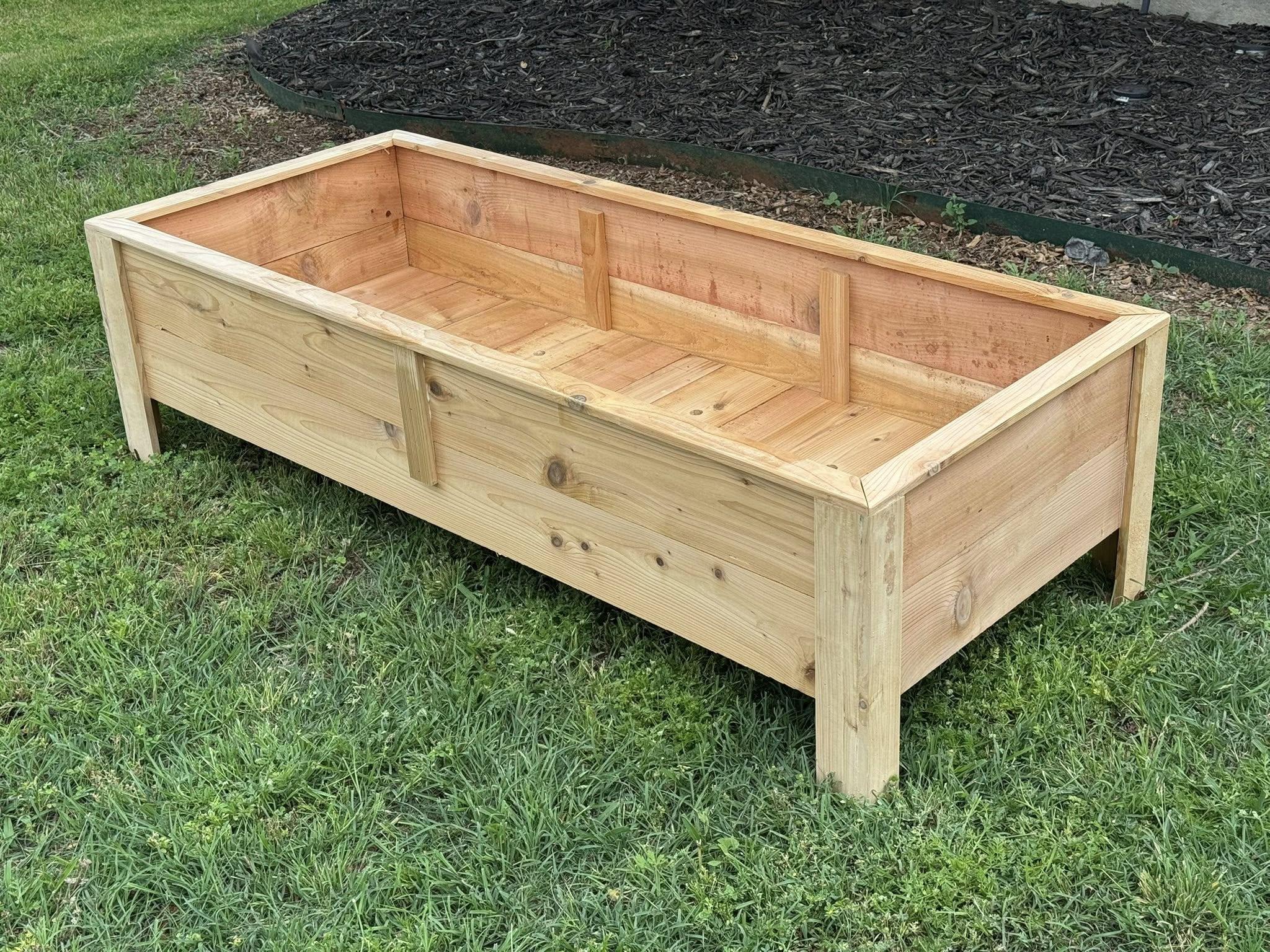
Elevated Raised Bed.
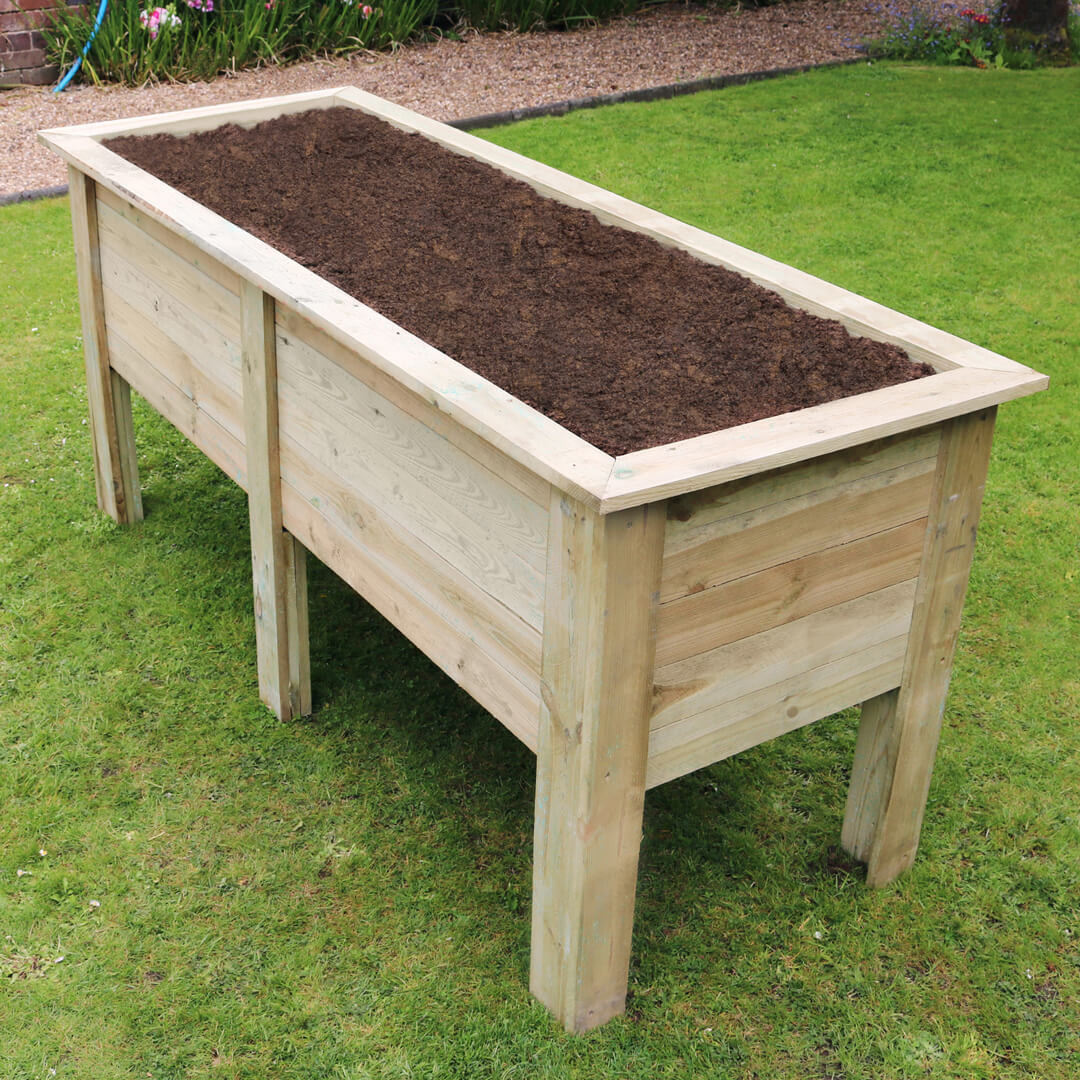
Elevated Raised Bed.
Mirliton Waterlogging: Symptoms and Quick Treatments

Mirlitons don’t like wet feet. They spent some 26 million years evolving on the mountainsides of Mexico and Central America, where rain races downhill and barely gets a chance to soak into the porous slope soil before it’s gone. Our job as growers is to recreate those fast-draining, mountainside conditions down in the root zone. When we don’t, the vine lets us know — and the first thing it does is turn yellow.
Why a Waterlogged Mirliton Turns Yellow
Yellowing leaves — what botanists call chlorosis — aren’t always cause for alarm. Mirlitons constantly drop old leaves and push out new ones, so a little yellowing is just part of how the vine grows. Yellowing can also be a sign of disease, like powdery mildew or anthracnose. But when it shows up after a stretch of excessive rain, the most likely culprit is waterlogging: so much moisture in the soil that the roots can’t get any oxygen. Scientists call that oxygen starvation hypoxia.
Here’s what’s actually happening, step by step.
When water fills all the air spaces in the soil, the roots can no longer “breathe.” In response, the plant closes its stomata — the tiny pores on the leaf surface that handle gas exchange and keep the leaf from overheating. Meanwhile, down at the roots, the lack of oxygen forces them into an emergency metabolism that causes real damage and shuts down their ability to extract nutrients from the soil.
One of those nutrients is nitrogen — and nitrogen is a key building block of chlorophyll, the green pigment that captures sunlight and feeds the plant. So as the waterlogged roots stop delivering nitrogen, the chlorophyll breaks down, the green fades, and the leaf yellows and begins to die.
It gets worse underground. Waterlogged soil becomes chemically hostile: toxic compounds and acids accumulate around the roots, further crippling their ability to take up the little nutrition available. At this point, the plant is both drowning and starving.
Here’s what you can do. All these treatments are supported by scientific research (citations below)
1. You can do nothing. Most vines will recover from waterlogging on their own once the soil drains. The catch is time: the longer the roots sit in saturated soil, the more the vine weakens. Prolonged waterlogging lowers the plant’s resistance to anthracnose, stunts vine growth, and cuts into your harvest. Doing nothing is a gamble that gets riskier the longer the wet spell lasts.
2. Directly feed the roots oxygen: You can deliver oxygen directly to the suffocating roots with ordinary drugstore hydrogen peroxide (3%). When it hits the wet soil, it breaks down into water and oxygen, briefly re-oxygenating the root zone. Here’s how to use it: Mix the 3% peroxide with water at about 1 part peroxide to 4 parts water, and pour it slowly around the root zone — not on the leaves. Apply at most every 2–3 days, and only when a soil core still comes up saturated. Skip an application the moment the soil sampler core shows the soil is draining and crumbly again, even if “it’s been three days.” You can also look for new growth on the vine. That’s a sign the vine is recovering
3. Directly feed the leaves: Since the roots can’t take up nutrients while they’re drowning, you can deliver nitrogen straight to the plant through its leaves instead, bypassing the impaired root system. Potassium nitrate (13-0-46) is the right tool — you can buy it here. How to use it: Mix 1 teaspoon into a gallon of water and spray the leaves once a week, in the evening, so the solution has time to absorb before the sun hits it. If your vine is badly stressed, start at half a teaspoon per gallon to be safe, and watch for any leaf-tip burn. Important: Avoid all ammonium-based fertilizers while the vine is waterlogged — in oxygen-starved soil, ammonium actually makes things worse. Stick with the nitrate form.
4. Rain Guard it. You should have a rain guard in place before you even plant the mirliton. Only a rain guard can prevent waterlogging.
5. Soil sample it. Get a soil sampler. If you post a photo of the core sample that you pull, that’s the only way we can help you determine if your vine is waterlogged and when it’s safe to water it again.
4. Shade It. A waterlogged vine is already under stress, and its sun-capturing machinery is impaired. Piling hot, full-sun conditions on top of that just adds heat stress to water stress. A temporary shade cloth (around 30–40%) during peak afternoon sun eases that double burden while the vine recovers. Take it down after the rains pass so you don’t trap moisture and invite fungal trouble.
A few cautions: don’t make it stronger than this, since too much peroxide kills the helpful soil microbes along with everything else; test a small area first
Sources
- Wenjing Guan, “Recovering from Waterlogging Damage,” Purdue University Vegetable Crops Hotline — covers oxygen-releasing treatments and why nitrate (not ammonium) fertilizer helps flooded plants. https://vegcropshotline.org/article/recovering-from-waterlogging-damage/
- University of Florida IFAS Extension — foliar nitrogen after waterlogging is taken up through the leaves better than through damaged roots. https://edis.ifas.ufl.edu/publication/SS425
- Hydrogen peroxide / calcium peroxide re-oxygenating flooded root zones (snap bean study), Scientific Reports. https://www.ncbi.nlm.nih.gov/pmc/articles/PMC8917216/
- Foliar melatonin recovery in waterlogged pumpkin seedlings (a close cucurbit relative), PeerJ. https://peerj.com/articles/17927/

How We Diagnose Mirliton Diseases and Problems
Overview:
As most of you know, I provide free diagnosis and treatment for mirliton plant diseases and problems to this group. I’m also training Tedra Stanley and Michelle Impastato Glore to do the same. I’m not a formally trained plant pathologist, but have learned through over 40 years of growing mirltons and researching scientific studies on plant diseases.
Expertise matters: You don’t go into your doctor’s waiting room and ask other patients, ‘What’s wrong with me?’ You wait until you see the doctor.
Here are the six steps that we follow when diagnosing and treating your mirliton problems, and the underlying theory behind our approach to handling plant problems whenever you post a photo and ask, “What’s wrong with my mirliton?”
- First, we ask questions:
Lots of them. Because each grower is unique, different varieties, different soils, different beds, different weather, and different watering methods (overhead or base). We need this information to accurately diagnose the problem. When you take a child to a doctor with what you think may be measles, you reasonably expect the first question out of the doctor’s mouth will be, “Has your child been around anyone who has measles?” We need this information because, unlike a professional plant pathology laboratory, we don’t examine the fungi on leaves and stems with a microscope, so we must rely on visible photographic signs of the disease and the plant symptoms-in-context (the plant’s response and its full history).
After you answer the questions, we may ask for additional close-up photos of the plant’s leaves and of the affected leaf or stem. Good close-up photos of the leaves are indispensable because we rely on visible signs of the diseases to diagnose them.
After that, we move forward with our approach to remedying the problem and the theory on which it is based, borrowed from medical doctors: a stepped care model.
2. Can You Get a Quick Diagnosis? Maybe:
If you walk into a doctor’s office with a nail in your foot, no questions are necessary. Same with mirlitons; sometimes we can immediately recognize the problem and recommend treatment. But generally, we need to proceed in smaller steps to give you the most accurate diagnosis and effective treatment.
3. Preliminary Diagnoses:
We will offer a tentative diagnosis of the problem — and it may not even be a disease. It may be due to environmental factors — hardening off, transplant shock, chill damage, insects, over-watering, excessive rain, or sun. We will ask you to flag healthy leaves to see if the symptoms are spreading,
4. Eliminate the Possible Causes other Than Disease:
We first try to eliminate all other possible causes before we progress to the more disease-focused ones. Using the stepped care model, we will start with the least complicated remedies, ruling out other causes before progressing to more disease-focused ones. The problem might be insects or soil moisture, so we want to try insecticides, adding shade, or changing soil moisture to see if that remedies the problem. We don’t want to amputate limbs if you just need a bandage. We want to minimize your work and costs. Medical doctors refer to it as “starting with conservative treatment.”
5. Disease Diagnoses and Treatment Plan:
If we go through all these steps and none of them correct the problem, we will go to the final step: identifying the disease and providing a treatment plan. We will recommend the simplest and least expensive fungicide.
Powdery Mildew and Anthracnose:
The two principal diseases that most frequently afflict mirlitonst are powdery mildew and anthracnose.
Powdery mildew has a simple cure. There’s a time-tested, inexpensive fungicide that will eradicate it: potassium bicarbonate. You only have to apply until the symptoms are gone.
Anthracnose is not so easy. There is no inexpensive and proven solution. The fungus that causes the disease has developed resistance to most chemical fungicides. We are currently testing an organic biofungicide — Timorex Act — but we have not yet obtained conclusive results. And it is very expensive because the company that makes it sells it only by the gallon.
The good news is that although most vines will eventually contract anthracnose, almost all will survive the infection without fungicide and will emerge with some acquired resistance to protect them from the disease the next year.
The most effective way to naturally protect the vine is to reduce water stress (over-saturation) and excessive exposure to solar radiation (by using shade cloths in the summer).
6. Final Step: Report Back so We Can do our job better:
The final step is to ask you to report back the results of any of the solutions we suggest, so we can get better at what we do!
DeBay Hydroponic Method for Growing Mirlitons (Chayote)
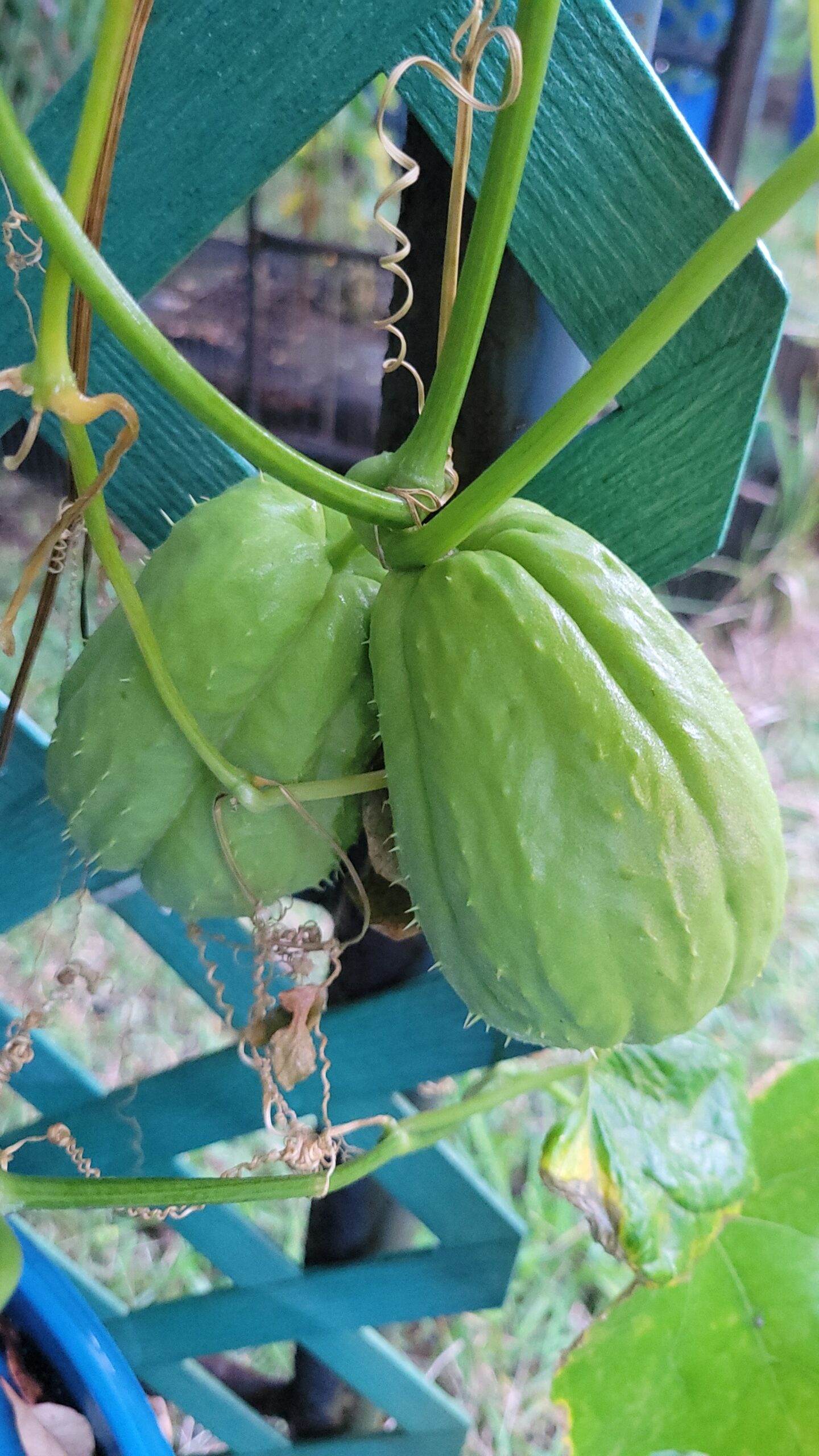
Two fruits on the DeBay Hydroponically-Grown Mirliton Vine
A Cool Weather Hydroponic Method of Growing Mirliton (Chayote) Vines and
Fruit in a 55 Gallon Blue Barrel
Perfected use of “Kratky Method” by William DeBay, on location in Haverhill, Florida
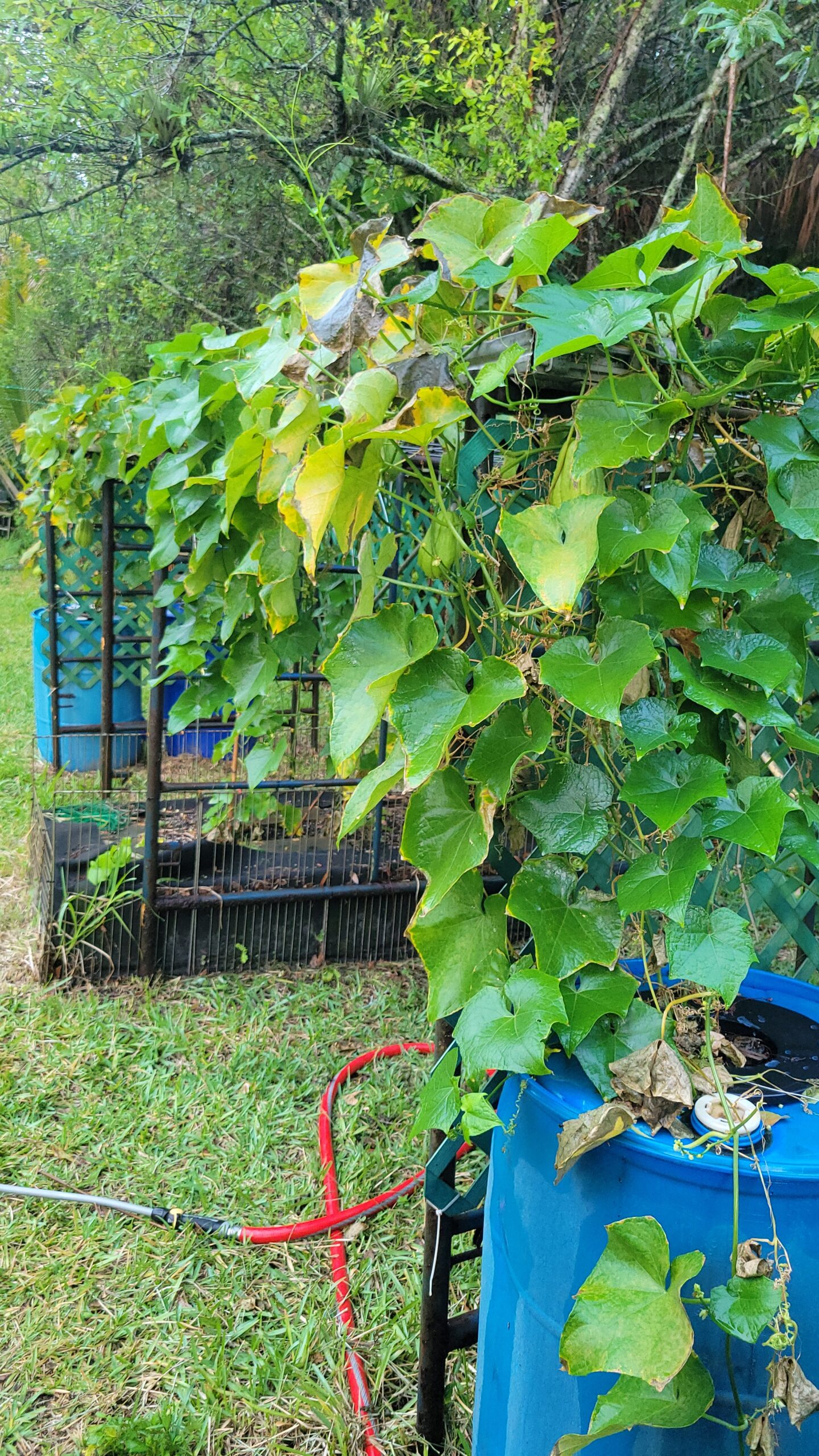
DeBay Hydoponically-Grown Mirliton
The following method was used in a 95-day period from January 10, 2026, to April 15, 2026, to achieve sprouting, vine growth, flowering, fruit set, and harvest of germinating Mirlitons.
This method is best suited for producing a quick harvestable crop in the cooler, short-day months of spring or fall. It should not be used in the summer months. Don’t use a smaller container, and keep the barrel out of direct sunlight because, as the water temperature rises, nutrient uptake is hindered. Wrap the barrel in silver reflective insulation, a radiant barrier, to mitigate the potential for hot water temperatures and algae growth. The nutrient solution is generally not changed during the process. It is allowed to drop to a certain level and then kept there with periodic small additions of nutrient solution.
Supplies:
Sprouting (germinating) mirliton fruit
Clean 55-gallon blue barrel (with fixed lid and 2 bungholes with screw caps)
5-gallon bucket
6” Net Pot Bucket Lid Insert
6” hole saw (or other preferred cutting tool)
Drill and 1⁄4” drill bit
Reflective insulation radiant barrier
Nutrients: (MasterBlend (4-18-38), Epsom Salt (Magnesium Sulfate), Calcium Nitrate (15.5-0-0)
Grams scale
pH measure (strips or meter)
EC (Electrical Conductivity) meter
pH Up and pH Down solution
Planting medium: PRO-MIX Premium Organic Garden Mix (or other preferred non-organic medium)
Procedures:
1. Place the 6” Net Pot Bucket Lid Insert on top of an empty 5-gallon bucket (on a level surface).
2. Add enough chlorine-free water to the bucket so that the bottom inch of the net pot is
submerged in water.
3. Remove the 6” Net Pot Bucket Lid from the bucket. For future reference, measure the distance
from the surface of the water to the top of the 5-gallon bucket rim.
4. Add to the water 4g Masterblend (4-18-38) and stir until dissolved.
5. Add to the water 2g Epsom Salt and stir until dissolved.
6. Add to the water 4g Calcium Nitrate (15.5-0-0) and stir until dissolved. This prescribed order in
which the nutrients are added to the water should never be changed. Masterblend (4-18-38)
should always be the first item. The next item should always be Epsom Salt. The last item should
always be the Calcium Nitrate (15.5-0-0).
7. Fill the net pot with moist planting medium.
8. Plant the sprouting mirliton into the planting medium in the same manner as it would be
planted in the ground. Plant the whole sprouting fruit at a 45-degree angle about 2/3 of the way
down with the sprouted end down in the planting medium. A thin support stick can be inserted
in the planting medium at this time.
9. Return the Net Pot Bucket Lid (with planted mirliton) to the 5-gallon bucket. The water level will
initially wet the bottom inch of the planting medium.
10. Place the assembled bucket planter under cover in indirect sunlight. Monitor the plant, being
sure that the planting medium stays moist but not wet. Mist with water if it looks dry.
11. The mirliton will grow one or more vines and will send roots down through the medium and into
the diluted nutrient solution.
12. The lid can be lifted periodically to check on the root growth progress. When several roots have
extended at least 5 inches out of the bottom of the net pot and into the water, the vine can be
hardened off for the final planting location. Leave the lid and the vine on the bucket during the
hardening process.
13. Cut a 6-inch hole in the center of the barrel end (the top end that includes the bungholes).
14. Drill several 1⁄4 inch drain holes along the edge of the same end of the barrel. There is a ridge
around that end of the barrel. The drain holes must be made to prevent water from collecting
on top of the barrel. Be careful not to drill into the inside of the barrel.
15. Rinse out the barrel.
16. Wrap the barrel in a reflective insulation radiant barrier.
17. Place the insulated barrel (hole side up) in the location you plan to grow the mature vine.
18. Fill the barrel half full with unchlorinated water.
19. Add to the barrel water 120g Masterblend (4-18-38) and stir until dissolved.
20. Add to the barrel water 60g Epsom Salt and stir until dissolved.
21. Add to the barrel water 120g Calcium Nitrate (15.5-0-0) and stir until dissolved.
22. A measurement was made in step 3. Now, add 3 inches to the measurement in step 3.
23. Fill the barrel with additional water until the level below the hole is the measurement distance
computed in step 22. Stir the contents of the barrel.
24. Check the pH of the nutrient solution in the barrel and adjust if not between 5.5 and 6.0. pH Up
and pH Down can be used to adjust the pH.
25. Move the Net Pot Bucket Lid (with rooted and hardened mirliton vine) from the 5-gallon bucket
and place the pot into the center hole of the barrel. Be careful not to damage any roots. If step
23 was done correctly, the roots will be in the water, but the water will not be touching the
bottom of the Net Pot.
26. The Kratky method is a passive, low-maintenance hydroponic technique developed by Dr.
Bernard Kratky, who grows plants without pumps, electricity, or aeration. As roots consume
water, an air gap forms for oxygen, allowing plants to grow to maturity, ideally, with a single
initial fill. However, a mirliton vine will require the addition of replacement nutrient water as it
matures. Do not let the water level drop by more than 50%. If the level is going below fifty
percent, it should be replenished, but do not replenish more than a gallon of nutrient fluid per
day. Adding too much liquid at a time runs a risk of killing the “air roots” that develop in the air
space. Refill nutrient solution can be mixed in a separate 5-gallon bucket of water as follows:
1. Add to the water 12g Masterblend (4-18-38) and stir until dissolved.
2. Add to the water 6g Epsom Salt and stir until dissolved.
3. Add to the water 12g Calcium Nitrate (15.5-0-0) and stir until dissolved.
Store this bucket of refill nutrient solution, with the lid on, in a cool, dark location. Temporarily
remove the bunghole caps to test and refill the nutrient solutions in the barrel.
27. Monitor the pH and EC level on a regular basis and adjust accordingly. pH should ideally be
between 5.5 and 6.0. EC should ideally be between 2.0 and 2.5.
How to Use a Soil Sampler to Prevent Watering Problems and Diseases in Mirlitons
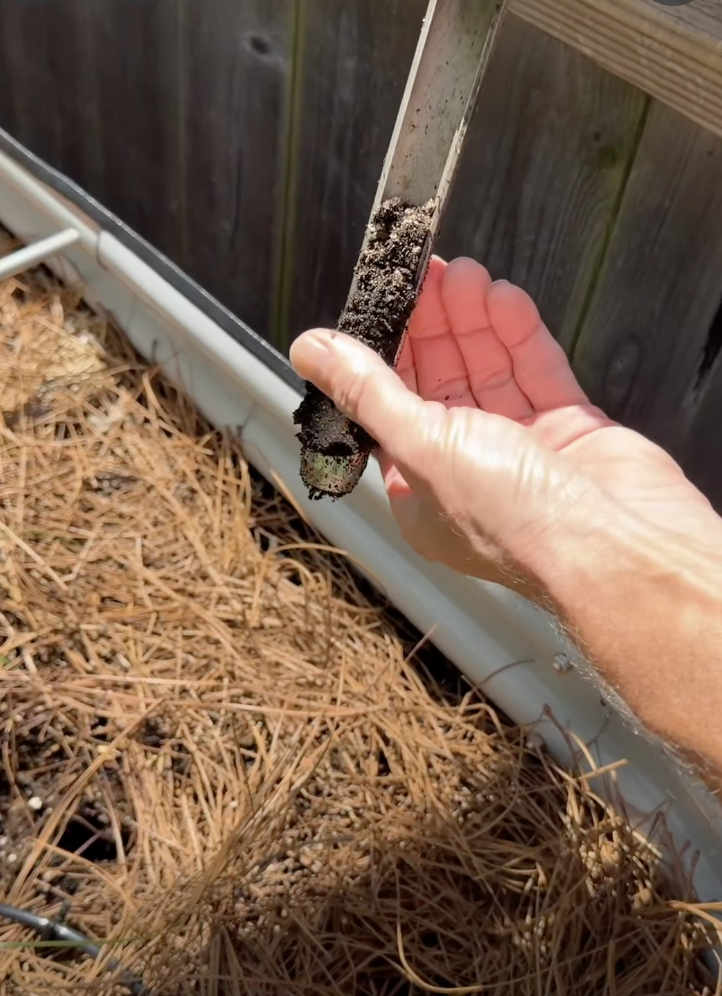
Michelle Impastato Glore takes a soil sample from her raised bed.
If you felt feverish and wanted to check your temperature, you wouldn’t guess; you would get a thermometer and take your temperature. Your garden soil is no different, and we now have a way to determine exactly how much soil moisture your mirliton has available: the soil sampler.
The soil sampler is the simplest way to see how much moisture your mirliton roots are getting. It’s the quickest and most inexpensive way to determine if you have overwatered or underwatered your vine and to help prevent anthracnose. Knowing what is happening several inches below the surface is even more important during droughts — many growers lost their vines during the heatwaves in 2023 and 2024 because the soil was starved of moisture.
The “knuckle” method of sticking your finger into the soil only tells you what the soil moisture is near the surface; that method does not work with mirlitons because the roots extend downward 8″. Electric meters are also ineffective because they measure electrical conductivity–not soil moisture. The only way to know the available soil moisture beneath your mirliton is to see and feel it, and that’s exactly what a soil sampler lets you do. Mirliton growers in Brazil have used this method for years.
Michelle Impastato Glore demonstrates how easy it is to take a sample and check moisture levels at all root zone levels. First, insert the sampler, twist 180°, and pull a core sample. Then, examine the soil by pressing down on it in the sampler at intervals of about every inch. Feel for moisture and how it compresses. That will indicate the amount of moisture present at each level. If it’s bone-dry and crumbly, it needs more water. If it’s muddy–it has too much. After a while, you will be able to easily take a reading by touch and sight. The soil will generally be moist at the surface, and it should even out as you go down about 8 inches.
See how Michelle does it here.
Buy a 12″ soil sampler here
If you have a deep raised bed, some growers prefer the 20″ soil sampler, which you can buy here.
We’ve Made an Important Discovery That May Change How You Grow Mirlitons: Female Flowers Dominate in the Spring.
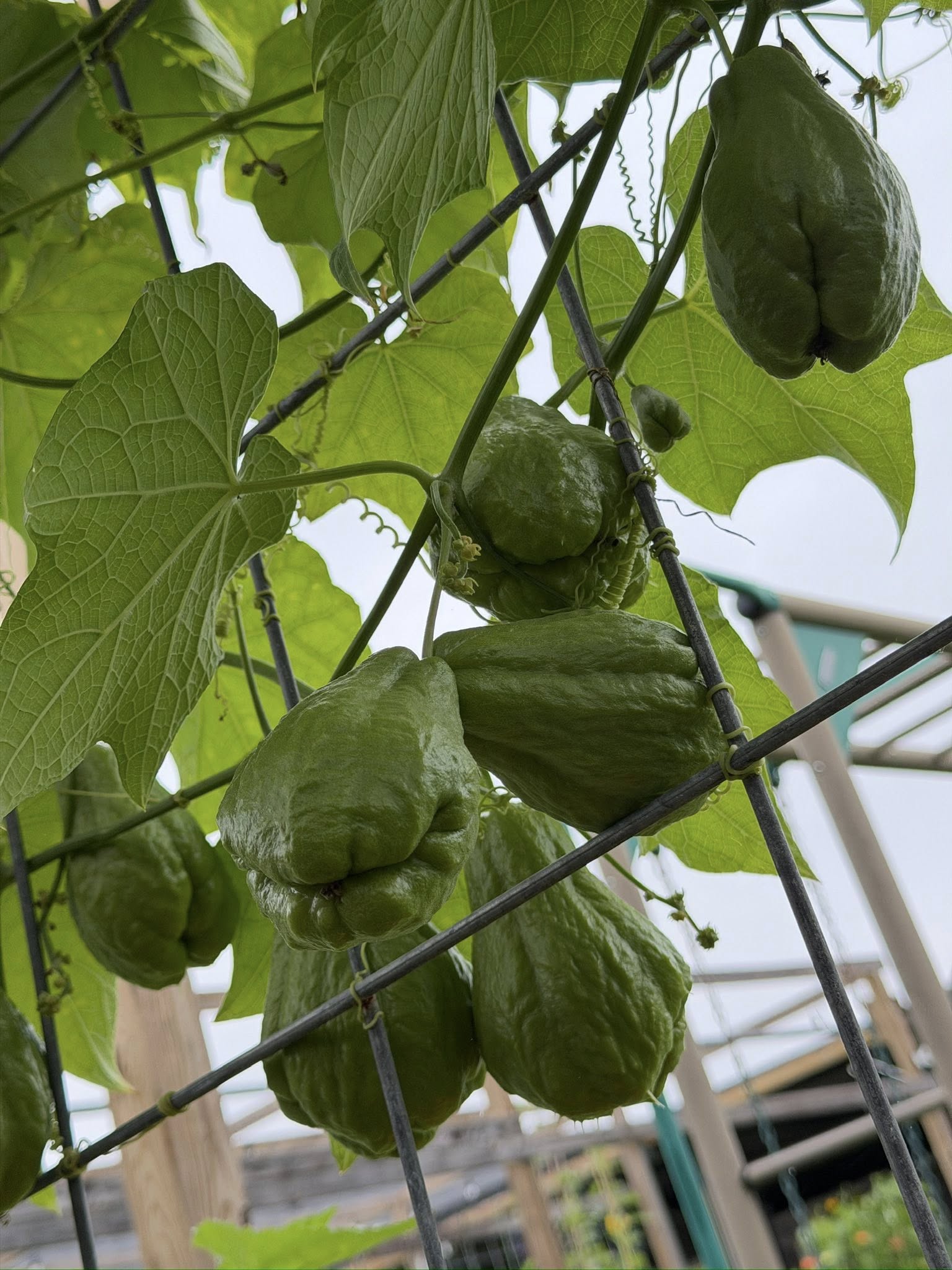
Michelle Impastato Glore’s 2026 Spring Mirlitons
We’ve made an important discovery that may change how we grow mirlitons in the U.S.A.
I say “we” because it was the observations made by growers in the Mirliton Facebook group that sparked my interest in why spring mirlitons were flowering females long before males–the exact opposite of the fall flowering sequence. And the reason is that one of the best ways to consistently harvest amid radically changing weather patterns is to focus on getting a spring crop. The fall crop is bedeviled by summer anthracnose epidemics, heat waves, heat domes, droughts, and then fall hurricanes and near-miss traumatic winds. The spring is not.
And here’s why.
The reason mirltons tend to produce females (pistillates) first in the spring is cool weather. This tendency for cool weather to produce female blooms earlier has long been observed in other cucurbits such as cucumber, melon, and squash, and we used that insight to extrapolate that mirlitons were doing the same. All mirliton flowers originate at the axil where the buds emerge. They can turn into a male or female flower. While initial flowering is stimulated by daylight length, the sex of the flower depends on cool night temperature and light intensity. All these factors combine to release hormones that determine whether a floral bud becomes a boy (staminate) or a girl (pistillate). That explains how the cool nights, short days, and lower light in the spring generally accelerate the appearance of females first.
That’s good news because it means that spring flowering and fruiting occur long before the summer heatwaves, droughts, the anthracnose epidemic, and fall hurricanes.
The spring may be your best bet for a crop–not your only crop–but your best bet for at least one crop.
So, how can we take advantage of this discovery?
- If you are starting with a sprout, container plant it as soon as possible in the fall in a 3-gallon container so the biological clock starts ticking. We know that when a sprout has been in the soil–any soil–it will flower and fruit within 110-120 days. So if it is transplanted in the first week of March, it will have time to develop a good canopy and flower lots of females during the ideal spring weather. Always overwinter in containers, then plant in the first week of March. (You can run out and tarp it in the event of a frost)
- If you have an established vine, don’t cut it back in the fall. If you cut back your vine at the end of the fall, you are eliminating your chances for a crop during the safest growing season of the next year—the spring. Frost-protect it through the fall and winter so it emerges with a large canopy that can host hundreds of female flowers in spring. That canopy will receive the full benefit of the cool temperatures during January-April that trigger female flowering. Growers who tent and heat their vines will be blessed with a sure-fire spring crop. And if all things go well in the summer, you will also get a fall crop — that’s just a bonus crop.
- Freeze the male pollen. Males tend to arrive late in the spring, long after the females appear, and this can be a temporary problem because there’s no one to pollinate the females. But we know that Mirliton pollen can be frozen and is viable for at least a year. You can collect male pollen the previous fall, freeze it, and then hand-pollinate the females in the spring. We are working out the specifics of freezing pollen, and we will post the instructions separately–but it’s easy.
So Spring Up to Success Through Science!
Checklist for Transplanting a Containerized Mirliton Plant

Checklist for Transplanting a Containerized Mirliton Plant
✔ Harden off the potted plant before transplanting–or erect a shade cloth for the first week
✔ Plant in fast-draining, composted soil
✔ Add manure or slow-release fertilizer
✔ Water thoroughly the first time.
✔ Use a bamboo stake or soil sampler to determine when to water subsequently
✔ Protect from cold damage if the temperature drops below 50℉