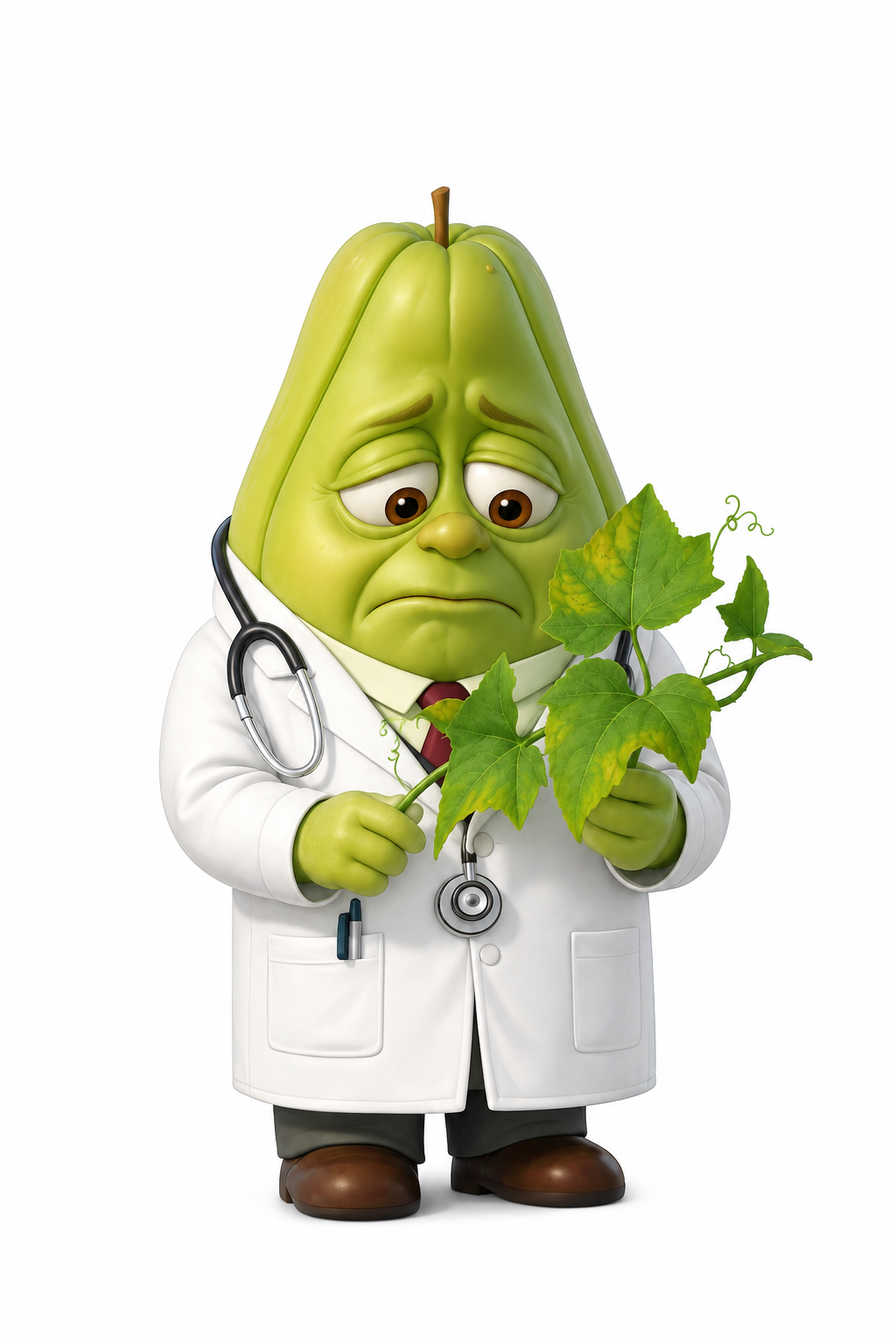
Overview:
As most of you know, I provide free diagnosis and treatment for mirliton plant diseases and problems to this group. I’m also training Tedra Stanley and Michelle Impastato Glore to do the same. I’m not a formally trained plant pathologist, but have learned through over 40 years of growing mirltons and researching scientific studies on plant diseases.
Expertise matters: You don’t go into your doctor’s waiting room and ask other patients, ‘What’s wrong with me?’ You wait until you see the doctor.
Here are the six steps that we follow when diagnosing and treating your mirliton problems, and the underlying theory behind our approach to handling plant problems whenever you post a photo and ask, “What’s wrong with my mirliton?”
- First, we ask questions:
Lots of them. Because each grower is unique, different varieties, different soils, different beds, different weather, and different watering methods (overhead or base). We need this information to accurately diagnose the problem. When you take a child to a doctor with what you think may be measles, you reasonably expect the first question out of the doctor’s mouth will be, “Has your child been around anyone who has measles?” We need this information because, unlike a professional plant pathology laboratory, we don’t examine the fungi on leaves and stems with a microscope, so we must rely on visible photographic signs of the disease and the plant symptoms-in-context (the plant’s response and its full history).
After you answer the questions, we may ask for additional close-up photos of the plant’s leaves and of the affected leaf or stem. Good close-up photos of the leaves are indispensable because we rely on visible signs of the diseases to diagnose them.
After that, we move forward with our approach to remedying the problem and the theory on which it is based, borrowed from medical doctors: a stepped care model.
2. Can You Get a Quick Diagnosis? Maybe:
If you walk into a doctor’s office with a nail in your foot, no questions are necessary. Same with mirlitons; sometimes we can immediately recognize the problem and recommend treatment. But generally, we need to proceed in smaller steps to give you the most accurate diagnosis and effective treatment.
3. Preliminary Diagnoses:
We will offer a tentative diagnosis of the problem — and it may not even be a disease. It may be due to environmental factors — hardening off, transplant shock, chill damage, insects, over-watering, excessive rain, or sun. We will ask you to flag healthy leaves to see if the symptoms are spreading,
4. Eliminate the Possible Causes other Than Disease:
We first try to eliminate all other possible causes before we progress to the more disease-focused ones. Using the stepped care model, we will start with the least complicated remedies, ruling out other causes before progressing to more disease-focused ones. The problem might be insects or soil moisture, so we want to try insecticides, adding shade, or changing soil moisture to see if that remedies the problem. We don’t want to amputate limbs if you just need a bandage. We want to minimize your work and costs. Medical doctors refer to it as “starting with conservative treatment.”
5. Disease Diagnoses and Treatment Plan:
If we go through all these steps and none of them correct the problem, we will go to the final step: identifying the disease and providing a treatment plan. We will recommend the simplest and least expensive fungicide.
Powdery Mildew and Anthracnose:
The two principal diseases that most frequently afflict mirlitonst are powdery mildew and anthracnose.
Powdery mildew has a simple cure. There’s a time-tested, inexpensive fungicide that will eradicate it: potassium bicarbonate. You only have to apply until the symptoms are gone.
Anthracnose is not so easy. There is no inexpensive and proven solution. The fungus that causes the disease has developed resistance to most chemical fungicides. We are currently testing an organic biofungicide — Timorex Act — but we have not yet obtained conclusive results. And it is very expensive because the company that makes it sells it only by the gallon.
The good news is that although most vines will eventually contract anthracnose, almost all will survive the infection without fungicide and will emerge with some acquired resistance to protect them from the disease the next year.
The most effective way to naturally protect the vine is to reduce water stress (over-saturation) and excessive exposure to solar radiation (by using shade cloths in the summer).
6. Final Step: Report Back so We Can do our job better:
The final step is to ask you to report back the results of any of the solutions we suggest, so we can get better at what we do!