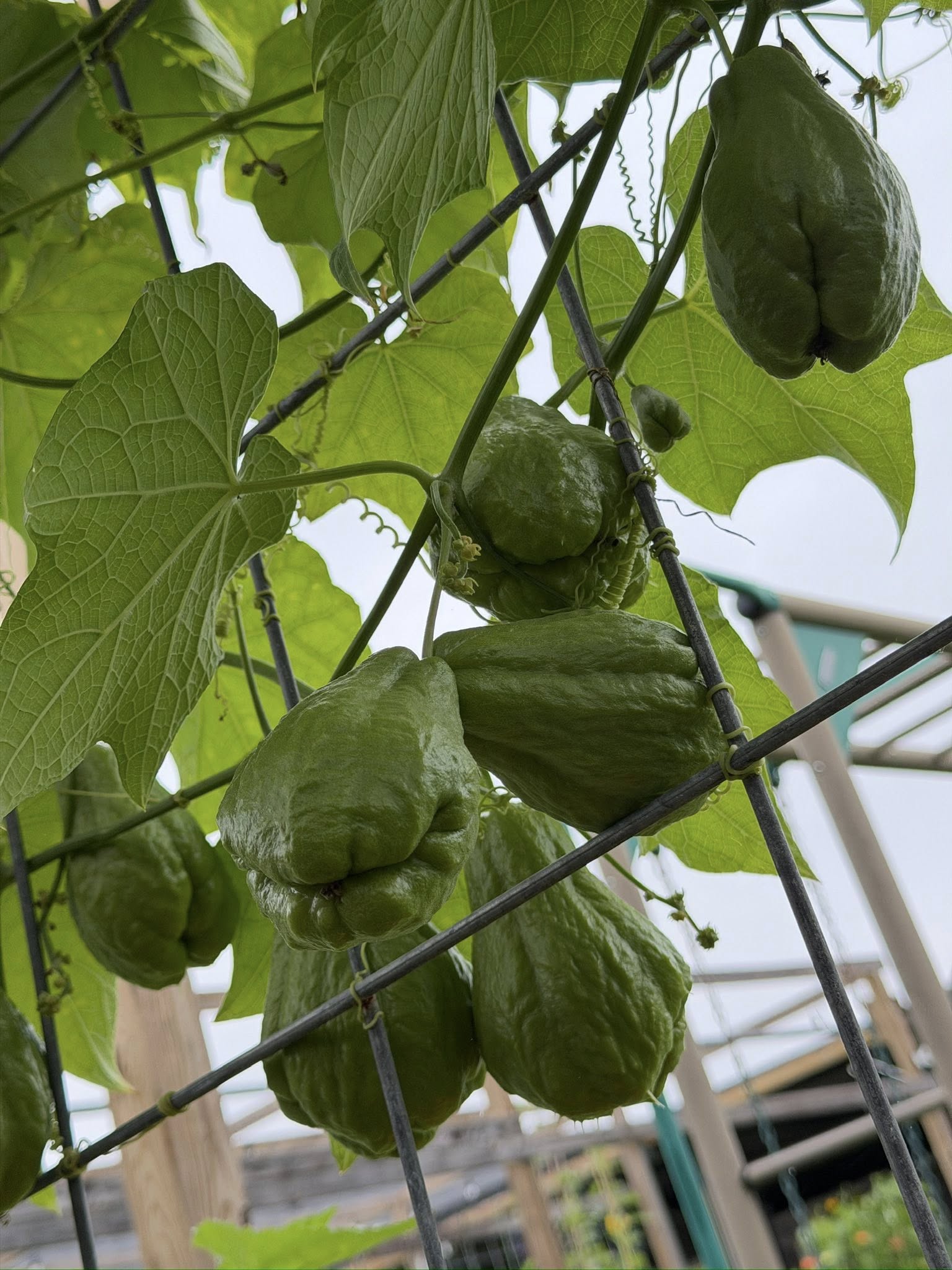
Michelle Impastato Glore’s 2026 Spring Mirlitons
We’ve made an important discovery that may change how we grow mirlitons in the U.S.A.
I say “we” because it was the observations made by growers in the Mirliton Facebook group that sparked my interest in why spring mirlitons were flowering females long before males–the exact opposite of the fall flowering sequence. And the reason is that one of the best ways to consistently harvest amid radically changing weather patterns is to focus on getting a spring crop. The fall crop is bedeviled by summer anthracnose epidemics, heat waves, heat domes, droughts, and then fall hurricanes and near-miss traumatic winds. The spring is not.
And here’s why.
The reason mirltons tend to produce females (pistillates) first in the spring is cool weather. This tendency for cool weather to produce female blooms earlier has long been observed in other cucurbits such as cucumber, melon, and squash, and we used that insight to extrapolate that mirlitons were doing the same. All mirliton flowers originate at the axil where the buds emerge. They can turn into a male or female flower. While initial flowering is stimulated by daylight length, the sex of the flower depends on cool night temperature and light intensity. All these factors combine to release hormones that determine whether a floral bud becomes a boy (staminate) or a girl (pistillate). That explains how the cool nights, short days, and lower light in the spring generally accelerate the appearance of females first.
That’s good news because it means that spring flowering and fruiting occur long before the summer heatwaves, droughts, the anthracnose epidemic, and fall hurricanes.
The spring may be your best bet for a crop–not your only crop–but your best bet for at least one crop.
So, how can we take advantage of this discovery?
- If you are starting with a sprout, container plant it as soon as possible in the fall in a 3-gallon container so the biological clock starts ticking. We know that when a sprout has been in the soil–any soil–it will flower and fruit within 110-120 days. So if it is transplanted in the first week of March, it will have time to develop a good canopy and flower lots of females during the ideal spring weather. Always overwinter in containers, then plant in the first week of March. (You can run out and tarp it in the event of a frost)
- If you have an established vine, don’t cut it back in the fall. If you cut back your vine at the end of the fall, you are eliminating your chances for a crop during the safest growing season of the next year—the spring. Frost-protect it through the fall and winter so it emerges with a large canopy that can host hundreds of female flowers in spring. That canopy will receive the full benefit of the cool temperatures during January-April that trigger female flowering. Growers who tent and heat their vines will be blessed with a sure-fire spring crop. And if all things go well in the summer, you will also get a fall crop — that’s just a bonus crop.
- Freeze the male pollen. Males tend to arrive late in the spring, long after the females appear, and this can be a temporary problem because there’s no one to pollinate the females. But we know that Mirliton pollen can be frozen and is viable for at least a year. You can collect male pollen the previous fall, freeze it, and then hand-pollinate the females in the spring. We are working out the specifics of freezing pollen, and we will post the instructions separately–but it’s easy.
So Spring Up to Success Through Science!