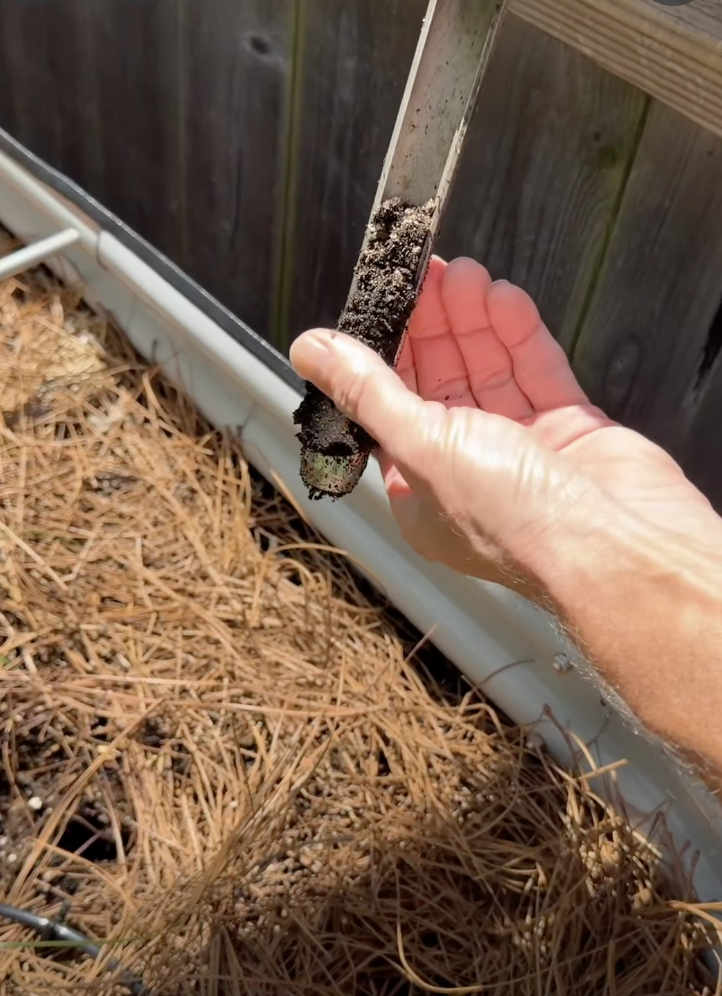
Michelle Impastato Glore takes a soil sample from her raised bed.
If you felt feverish and wanted to check your temperature, you wouldn’t guess; you would get a thermometer and take your temperature. Your garden soil is no different, and we now have a way to determine exactly how much soil moisture your mirliton has available: the soil sampler.
The soil sampler is the simplest way to see how much moisture your mirliton roots are getting. It’s the quickest and most inexpensive way to determine if you have overwatered or underwatered your vine and to help prevent anthracnose. Knowing what is happening several inches below the surface is even more important during droughts — many growers lost their vines during the heatwaves in 2023 and 2024 because the soil was starved of moisture.
The “knuckle” method of sticking your finger into the soil only tells you what the soil moisture is near the surface; that method does not work with mirlitons because the roots extend downward 8″. Electric meters are also ineffective because they measure electrical conductivity–not soil moisture. The only way to know the available soil moisture beneath your mirliton is to see and feel it, and that’s exactly what a soil sampler lets you do. Mirliton growers in Brazil have used this method for years.
Michelle Impastato Glore demonstrates how easy it is to take a sample and check moisture levels at all root zone levels. First, insert the sampler, twist 180°, and pull a core sample. Then, examine the soil by pressing down on it in the sampler at intervals of about every inch. Feel for moisture and how it compresses. That will indicate the amount of moisture present at each level. If it’s bone-dry and crumbly, it needs more water. If it’s muddy–it has too much. After a while, you will be able to easily take a reading by touch and sight. The soil will generally be moist at the surface, and it should even out as you go down about 8 inches.
See how Michelle does it here.
Buy a 12″ soil sampler here
If you have a deep raised bed, some growers prefer the 20″ soil sampler, which you can buy here.