Alternaria Leaf Spot/Blight in Mirlitons (Chayote)

by | Jul 1, 2025 | How To, Mirliton | 0 comments

Alternaria Leaf Spot and Alternaria Leaf Blight are two related plant diseases that affect mirlitons (chayote).  The fungus Alternaria cucumerina causes leaf blight, and the fungus Alternaria alternata f. sp. cucurbitae causes leaf spot. 
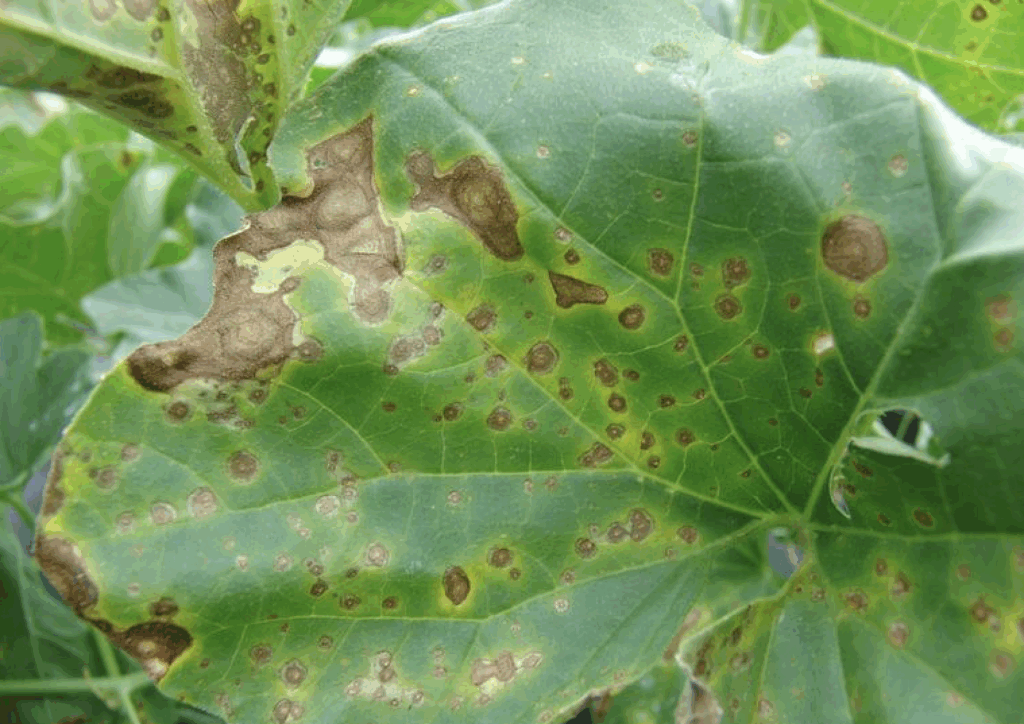
Alternaria leaf spot.

The disease first appears as brown leaf spots with a yellow halo, and as the spots coalesce, they can turn the entire leaf brown (necrotic) and cause it to die. At that stage, it’s referred to as “leaf blight.

Leaf spot starts with concentric black rings that often have a yellow (chlorotic) halo around margins. Although the disease primarily affects leaves, it also causes brown lesions on the stems.  Unlike anthracnose, alternaria does not penetrate the stems and block the flow of nutrients and moisture, so it won’t kill entire shoots and stems as does anthracnose.  The vine will lose leaves, but usually survives the disease and produces in the fall.

There is no known fungicide that can be used to treat it if the temperatures exceed 88℉.  Copper-based fungicides do prevent and eradicate the fungus, but they are phytotoxic in hot weather and can kill the plant.  There are products like Daconil that coat the plant with a film, making it difficult for the fungus to establish itself on the vine. However, it must be applied from spring forward, and there’s no scientific study that indicates it’s effective as a preventative on mirlitons.  Mirltion.Org is currently experimenting with a new biofungicide to test its effectiveness.

Treatment:

Do not water the vine from the top down–that will only spread the disease, as it also does with anthracnose. Remove all the dead leaves.

Because the disease primarily affects the leaves, the vine will continue to replace dead leaves with new ones. As a result, the vine will normally survive the summer and produce a crop in the fall.

Here is a link to several images of the disease on different crops.
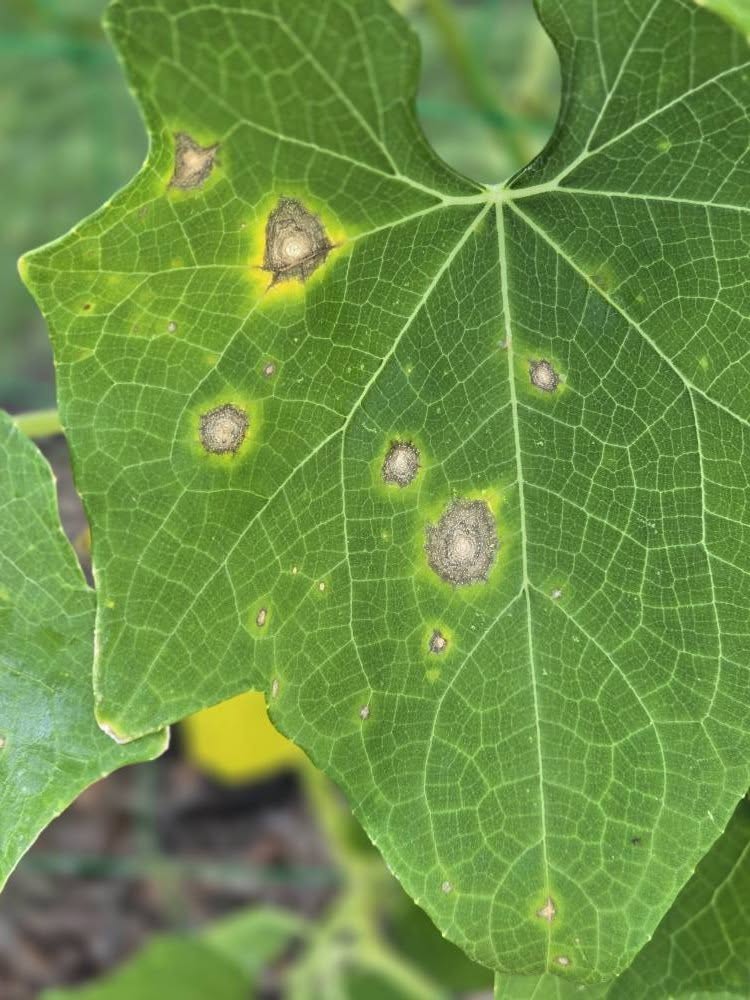
Alternaria Leaf Spot. Early stage.
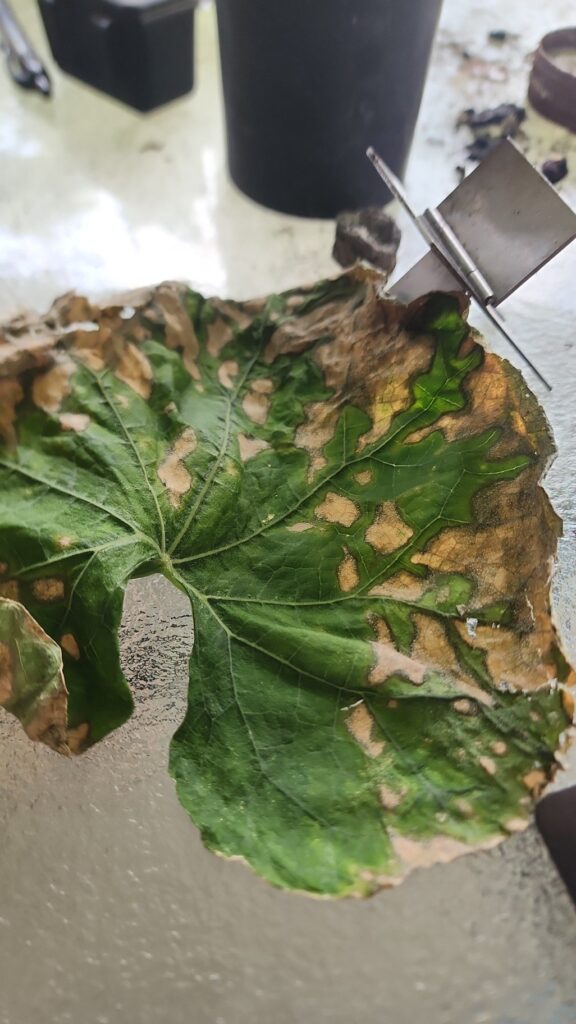
Advanced alternaria leaf blight. Soon, the entire leaf will become brown.


Recent Posts

Mirliton Waterlogging: Symptoms and Quick Treatments

Mirlitons don't like wet feet. They spent some 26 million years evolving on the mountainsides of Mexico and Central America, where rain races downhill and barely gets a chance to soak into the porous slope soil before it's gone. Our job as growers is to recreate those...

How We Diagnose Mirliton Diseases and Problems

Overview: As most of you know, I provide free diagnosis and treatment for mirliton plant diseases and problems to this group. I’m also training Tedra Stanley and Michelle Impastato Glore to do the same. I’m not a formally trained plant pathologist, but have learned...

DeBay Hydroponic Method for Growing Mirlitons (Chayote)

  A Cool Weather Hydroponic Method of Growing Mirliton (Chayote) Vines and Fruit in a 55 Gallon Blue Barrel Perfected use of “Kratky Method” by William DeBay, on location in Haverhill, Florida The following method was used in a 95-day period from January 10,...

How to Use a Soil Sampler to Prevent Watering Problems in Mirlitons

If you felt feverish and wanted to check your temperature, you wouldn't guess; you would get a thermometer and take your temperature. Your garden soil is no different, and we now have a way to determine exactly how much soil moisture your mirliton has available: the...

Checklist for Transplanting a Containerized Mirliton Plant

  Checklist for Transplanting a Containerized Mirliton Plant ✔ Harden off the potted plant before transplanting--or erect a shade cloth for the first week ✔  Plant in fast-draining,  composted soil ✔  Add manure or slow-release fertilizer ✔ ...

Vineguard: Protection From Sun, Rain, and Frost.

  Here’s an idea. Design an arched trellis structure to protect mirlitons from excessive rain, solar radiation, and cold. I call it a Vineguard. It can be used to shunt rain away from the beds, shield the vine from intense heat, and protect it from frost. ...