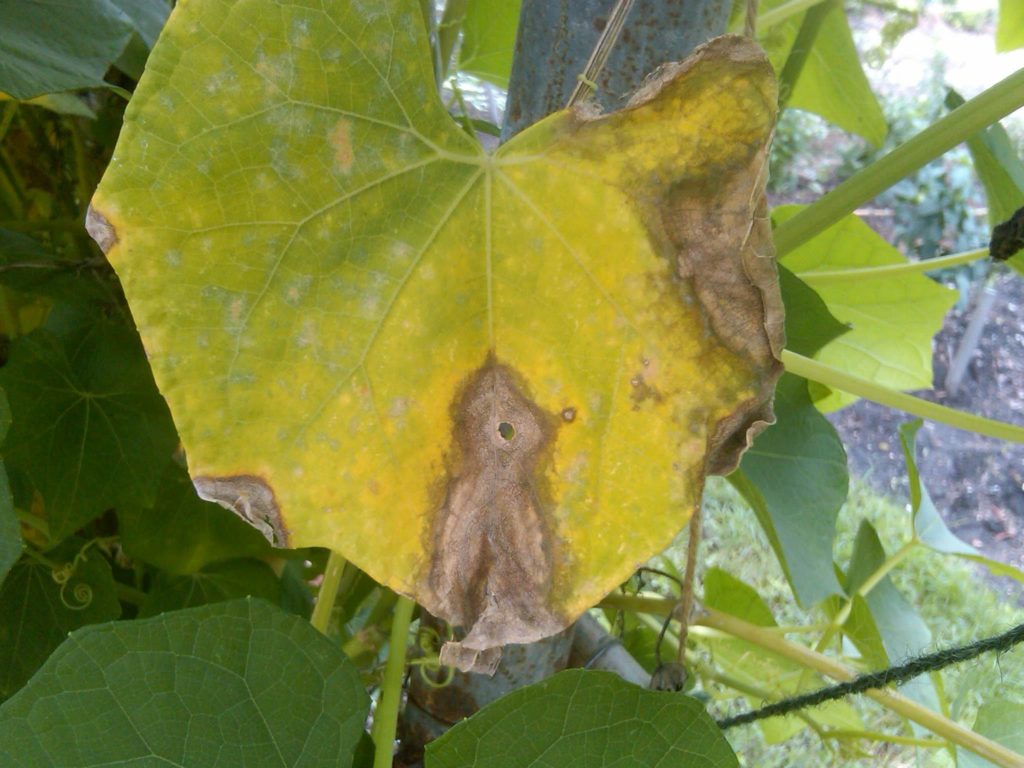
Mirliton leaf infected with anthracnose. Unlike powdery mildew, which yellows uniformly and wilts the leaves, anthracnose starts as yellow wedges between the leaf veins. It then turns the leaf tissue brown and leaves a distinctive “shot hole” in the middle of the brown patches. This is because the anthracnose fungus feeds on both living and dead tissue.
Seasons change, and diseases change. For mirlitons (chayote), the cooler, drier spring is time for the airborne mildews (powdery and downy), but the hot rainy months July through August—bring anthracnose season. Being prepared for it can significantly reduce the damage the disease might do.
First, know the enemy. The above photo shows all the classic signs of anthracnose: a yellow wedge that turns into dead, paper-like tissue, with a shot hole in the middle. If you got these, you got anthracnose.
Anthracnose is a disease caused by the fungi Colletotrichum lagenarium or Colletotrichum orbiculare in mirlitons. There are many fungi that cause anthracnose disease, but for our purposes, we’ll call Colletotrichum lagenarium the “anthracnose fungus.” Unlike mildews, which are carried by air, the anthracnose fungus is waterborne. That means it is carried by water droplets, splashing up from the soil and then from leaf to leaf. That’s important because it means that while you might be able to wash off some fungi with a good shower from your hose, the same shower will splash anthracnose fungus all over your vine and cause a massive anthracnose infection.
Three Steps to Manage Anthracnose:
- Don’t give your vine showers. Water from the bottom of the vine with a hose set on low or drip irrigation.
- Don’t drown the vine. Too much soil moisture stresses mirliton and makes it difficult for it to fight fungi. Make sure your raised beds and ground plantings have adequate drainage; if they don’t, add it now.
- Don’t worry; Be Happy. As horrible as anthracnose looks, infected vines normally recover in September and flower and fruit. Plus, they acquire increased resistance to the disease.
- We are testing a new biofungicide, Timorex Act, and will report on our findings when the trials are complete
Here’s a more complete fact sheet on anthracnose and how to protect your plant by prepping your planting site or raised bed::Here