Managing Spider Mites and Mealybugs

by | Mar 21, 2025 | How To, Mirliton | 0 comments

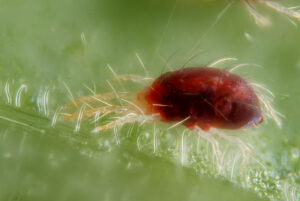
Female red spider mite.
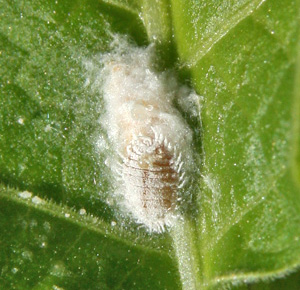


Mealybug and nest.


Spider mites and mealybugs tend to plague mirlitons that are planted in containers, especially when kept indoors during overwintering. 

You can manage mealybugs by soaking a cotton swab with 70% isopropyl rubbing alcohol and dabbing it directly on the bugs. Alternatively, you can dilute the alcohol with water at a 1:10 ratio (one part alcohol to 10 parts water) and spray it on both the top and bottom of the leaves.  (Sevin claims to control mealybugs, but there’s evidence that it is not as effective as alcohol.)  If you are spraying the solution on an established plant outside, do a patch test first to ensure that the alcohol won’t harm the leaves (spray only a few leaves and then check the next day).  Additionally, spray the plant in the evening.

If the mites are on a seed, sprout, or container plant that you are keeping inside or not in direct sun, you can dust it with “flowable sulfur.”  It’s very effective, but it can damage the sprout/plant if applied outside in direct sunlight or heat, so be cautious with it. 

Mites can be controlled with the same alcohol spray, neem oil, or insecticidal soap (follow the instructions on the label).    


Sprays will only kill the living mites, so you may need to repeat the spraying process weekly for a few weeks.
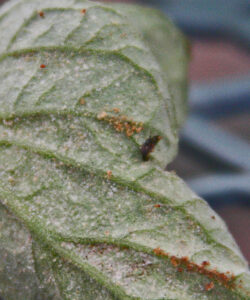
Red spider mite clusters.


Click here for a short fact sheet on how to identify signs of mites.

Click here for a fact sheet on mealybugs.

Recent Posts

Checklist for Transplanting a Containerized Mirliton Plant

  Checklist for Transplanting a Containerized Mirliton Plant ✔ Harden off the potted plant before transplanting--or erect a shade cloth for the first week ✔  Plant in fast-draining,  composted soil ✔  Add manure or slow-release fertilizer ✔ ...

Vineguard: Protection From Sun, Rain, and Frost.

  Here’s an idea. Design an arched trellis structure to protect mirlitons from excessive rain, solar radiation, and cold. I call it a Vineguard. It can be used to shunt rain away from the beds, shield the vine from intense heat, and protect it from frost. ...

How to Prune Back a Mirliton in a Container

Although we recommend trellising mirliton vines while they are in 3-gallon containers, some people prefer to prune them back. Pruning is safe and will result in a compact, bushy plant.   The most important point is that when you prune, leave at least three plant...

Lightweight Frost Protection: The Glore System

Growing mirlitons can be physically challenging for people like me, who have health or age problems that limit our ability to get around. Putting up frost protection can be a real headache.   Michelle Impastato Glore invented a solution: She uses lightweight...

Buyer Beware! How to Sell and Buy Mirliton Seeds, Sprouts, and Plants

  The Mirliton.Org Facebook group serves as a market for people to sell or gift mirliton seeds and sprouts. We want to ensure that only viable seeds are transferred so that people are guaranteed a successful growing experience. We don’t want to mandate standards...

How to Rescue a Raised Bed From a Flood

Noah couldn’t do it, nor can we, but Michelle Impastato Glore invented a brilliant idea: use a raised bed with a moisture barrier to overcome a saturated yard. The Outcome: She planted a new mirliton in September in the raised bed in her water-saturated yard, and four...

How Mirliton Sprouts Root When Containerized

 The photo shows that although the root radicles (white, bumpy protuberances at the top) are pointing upward, yet the roots themselves have begun to grow downward into the soil. The radicle is the embryonic root of the plant, and in this case, even though it was...