Mirliton How-To Tips
Search tips by keyword:

Vineguard: Protection From Sun, Rain, and Frost.
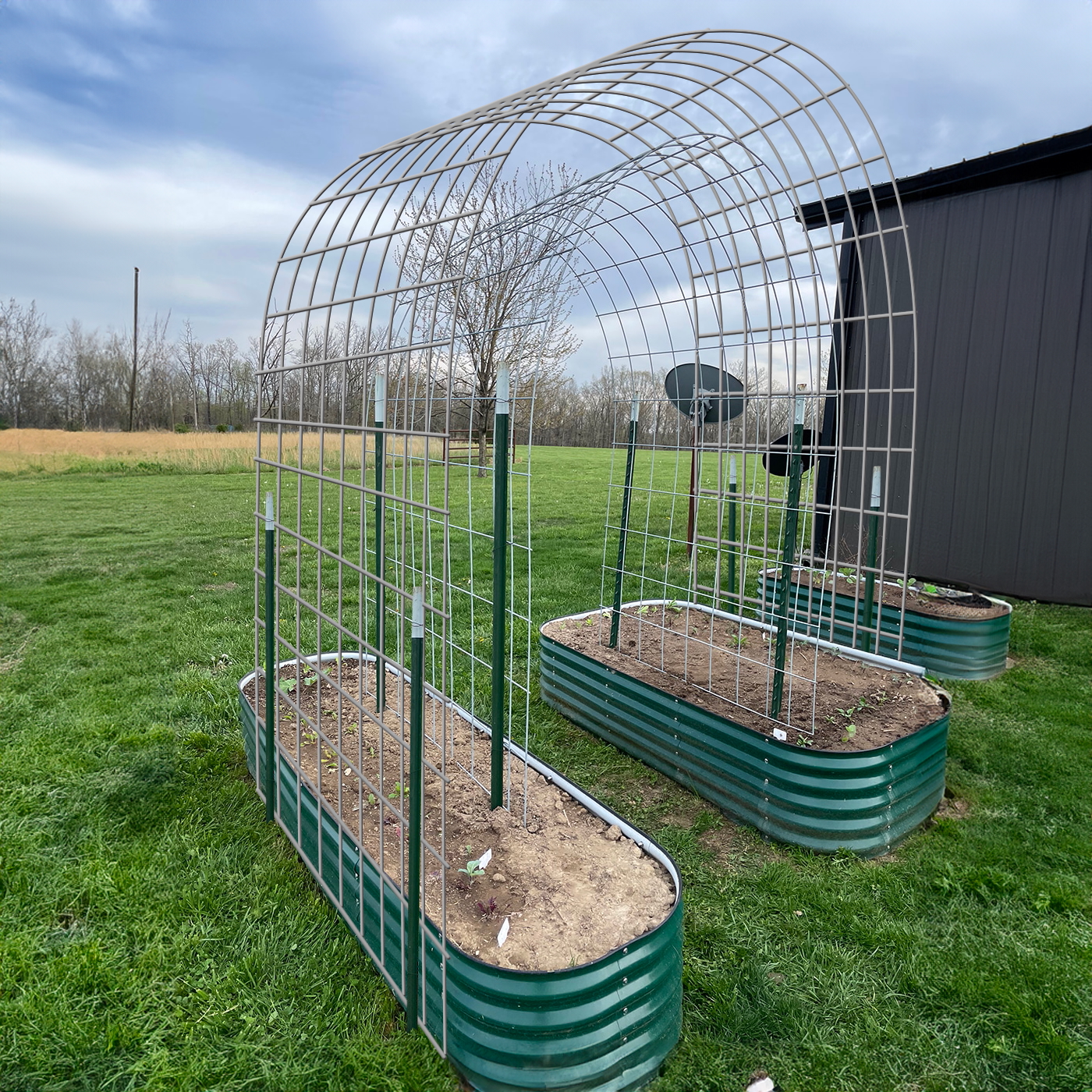
1. A cattle panel trellis with a Vineguard arch installed above it.
Here’s an idea. Design an arched trellis structure to protect mirlitons from excessive rain, solar radiation, and cold. I call it a Vineguard. It can be used to shunt rain away from the beds, shield the vine from intense heat, and protect it from frost.
One structure–three purposes.
We invite you to design and test the concept. (post your ideas and results on the Facebook group)
The concept is simple: An arching structure that you mount above the trellis, similar to the shade cloth structure that many of you already use–but sloped. During periods of heavy rainfall, place a single sheet of clear 6-mil plastic on top to divert the water away from the bed and prevent waterlogging. The single clear sheet will allow sunlight through and air circulation through the sides. In the summertime, replace it with a shade cloth to protect from the sun. In winter, you cover the entire trellis with plastic and enclose the vine to prevent frost damage.
The Vineguard can be built several ways. If you are already using an arched cattle panel, arch another one a few feet above it. If you’re using a horizontal cattle panel trellis, install a PVC pipe arch overhead that slopes to direct rainfall away from the bed (see photo). Or you can construct a similar pitched wooden frame with a pitched roof.
The Vineguard will work for both raised-bed and ground plantings, but it works especially well against waterlogging in tall raised beds. That’s because raised beds provide more control over soil moisture. Tall raised beds are less likely to wick moisture from the rest of the yard when it becomes saturated.
We will be experimenting with Vineguards this year, and I invite all you Mirliton Wizards out there to create designs that provide the simplest, most effective, and least expensive model.
Special thanks to R. Ranjith at the Nesamony Memorial Christian College for his advice on soil hydrology and managing intense rainfall.
Thanks to Buster Avera for the photo of his shade-cloth arch, which can also serve as a rain guard.
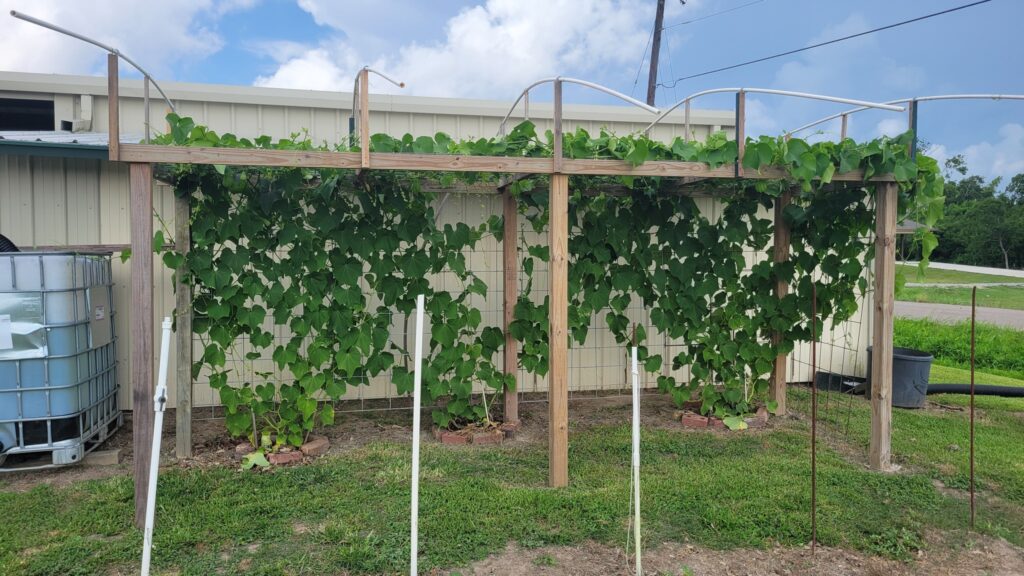
2. Buster Avera’s arched shade cloth structure could also easily double as a rain guard.
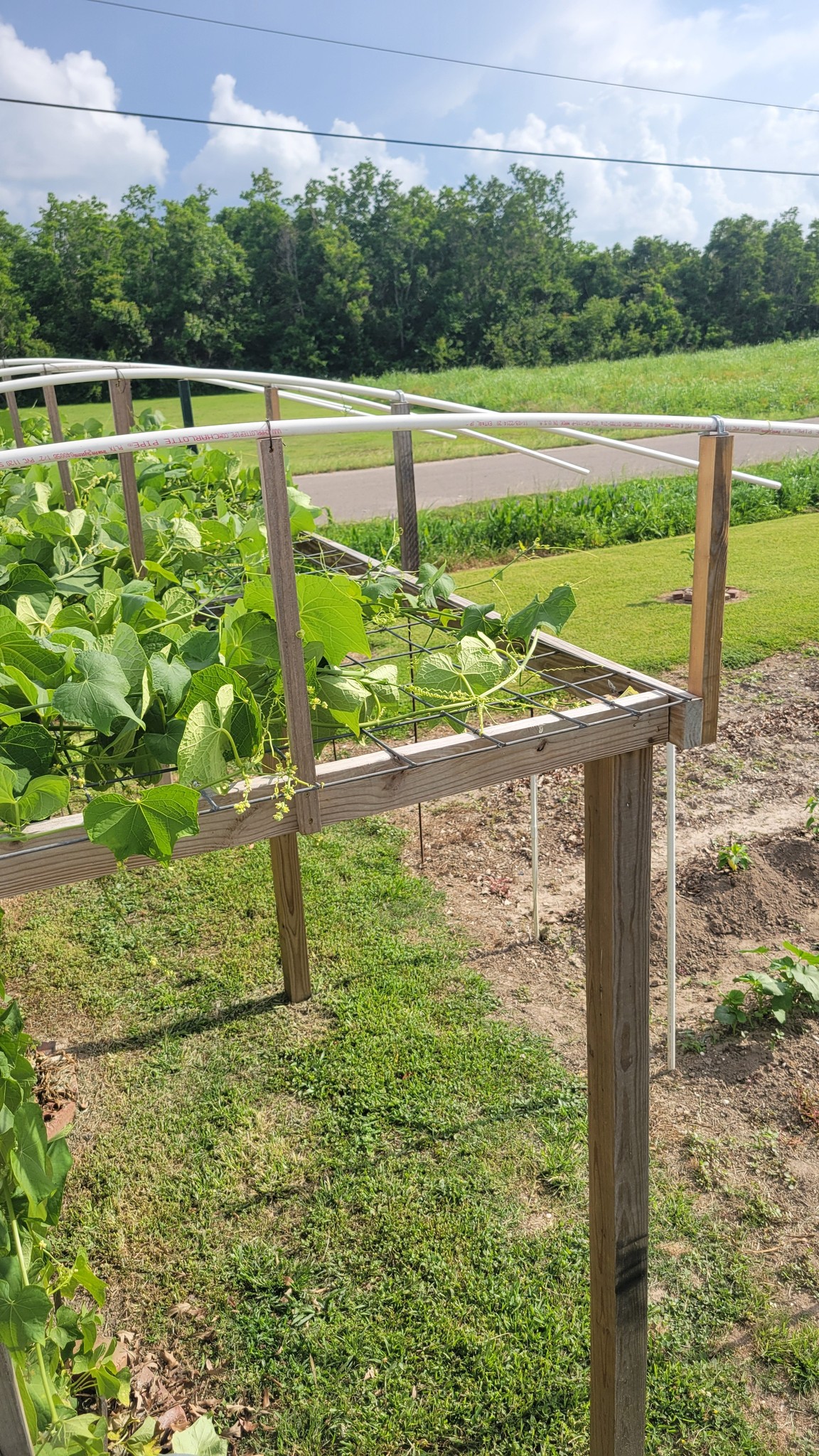
3. Corner view of Buster Avera’s arched shade cloth structure.
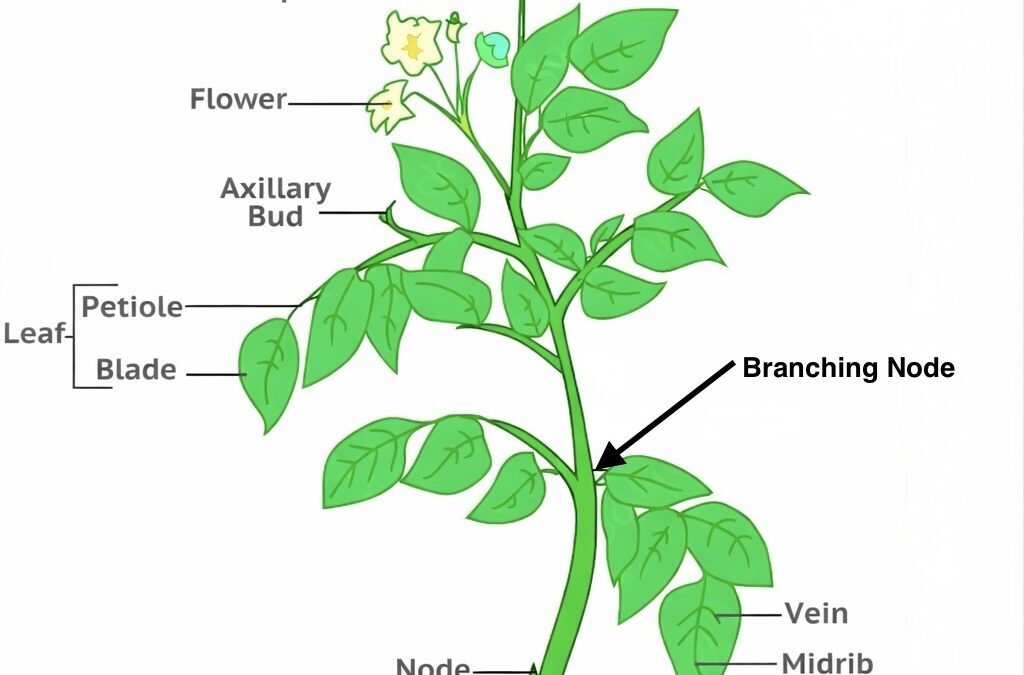
How to Prune Back a Mirliton in a Container
Although we recommend trellising mirliton vines while they are in 3-gallon containers, some people prefer to prune them back. Pruning is safe and will result in a compact, bushy plant.
The most important point is that when you prune, leave at least three plant nodes above the soil line. Nodes are the small protrusions at the joint of the vine stem that produce branches, tendrils, leaves, and flowers. If you eliminate too many nodes, you can hurt vine growth.
Follow the nodes up the stem and prune anywhere above the third node. A “branching node” is a node where a branch has emerged. Try to leave as many of these branching nodes as possible because they will produce a stronger, bushier plant.
Every part of the plant that you prune is edible. Many people use the shoots and leaves in stir-frys.

Nodes will appear every few inches. Leave at least three nodes when pruning back.
Mimi Noug Prejean demonstrates how to prune a mirliton plant in this 90-second video here.
Lightweight Frost Protection: The Glore System
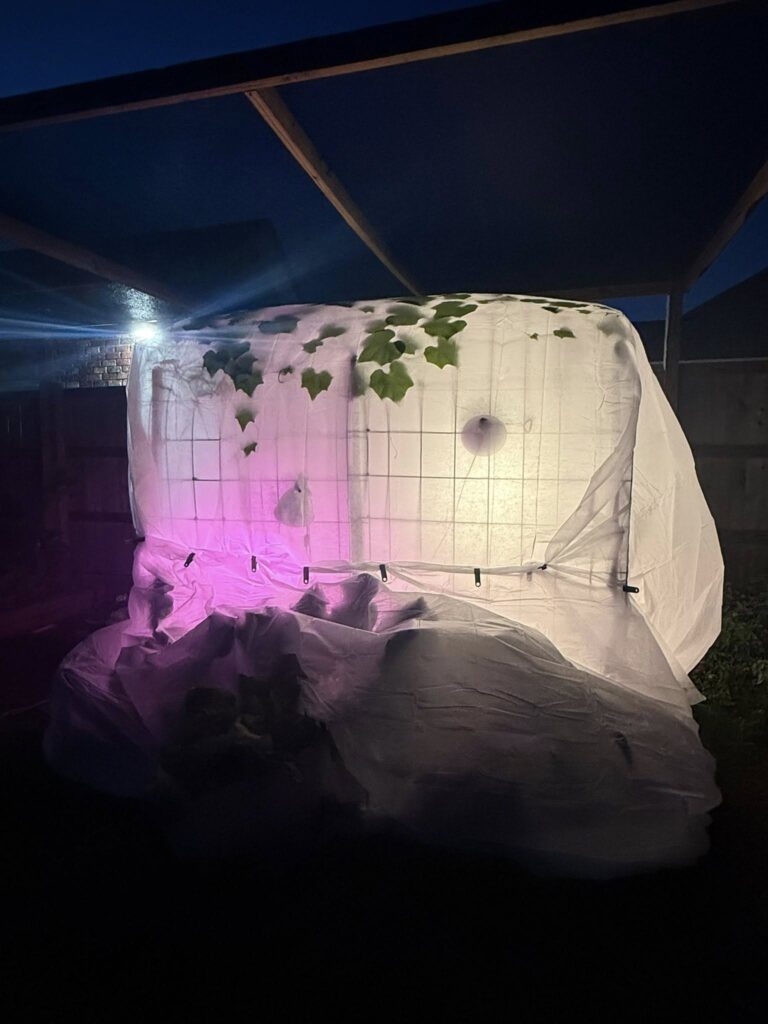
Michelle’s Glore’s lighted and heated row cover enclosure at night.
Growing mirlitons can be physically challenging for people like me, who have health or age problems that limit our ability to get around. Putting up frost protection can be a real headache. Michelle Impastato Glore invented a solution: She uses lightweight row-cover frost cloths that one person can easily mount and unmount with the aid of bamboo sticks. And her frost-protection enclosure keeps her mirlitons safe even when temperatures drop to 20°!
Most mirliton growers build temporary frost-protection enclosures using 6-mil plastic or Visqueen. Plastic works well, but it can be difficult and unwieldy for some people to manage the constant covering and uncovering of a trellis. A high trellis can be especially challenging for people with smaller stature or older adults (like me) with balance or walking impairments. Instead, Michelle chose to use multiple lightweight fabric row covers and bamboo canes, which makes the task easier.
A single frost cover will not retain enough heat to prevent frost, but multiple ones will. Make sure to layer three frost cloths, as Michelle does, to prevent damage. Additionally, row covers allow you to use clips to more easily secure them to the trellis. She also uses heat lamps and incandescent Christmas lights to heat the enclosure.
Here’s how she removes the frost cloths from the trellis using a bamboo stick.
Here’s a video of her explaining the materials she uses.
Here’s a video of how she disassembles the enclosure.
And here’s a video of the vine the morning after the temperatures were 20℉.
These are the tools for her lightweight frost protection:
Fabric row covers (frost cloths ) 10’x50′:

Fabric row covers.
Fabric Cover Spring Clips: 5” long:
W


Wireless remote thermometer.
Buyer Beware! How to Sell and Buy Mirliton Seeds, Sprouts, and Plants

The Mirliton.Org Facebook group serves as a market for people to sell or gift mirliton seeds and sprouts. We want to ensure that only viable seeds are transferred so that people are guaranteed a successful growing experience. We don’t want to mandate standards and prefer to make recommendations, with the hope that people will cooperate.
Buying Seeds and Sprouts:
We categorize mirlitons advertised on the Facebook site as either seeds or sprouts. Seeds are defined as the normal unsprouted mirlitons that you use for cooking. In contrast, sprouts are defined as fruit that has begun to sprout— to extrude the soft inner seed through the large end of the fruit. This is commonly referred to as “sticking its tongue out.” The “tongue” is where all the roots and shoots will grow from.
Not all mirliton seeds are viable. They may look like mature, healthy seeds, but vines can bear fruit that lacks the inner soft seed that would produce a new plant. We call this a “parthenocarpic” fruit. It occurs when a female flower is not successfully pollinated and has an unfertilized ovary. The seed will never germinate, and if you get one of these, you will be getting a dud. Only sprouted seeds are viable and will grow into an entire plant.
That’s why we recommend that, if you are selling or buying a seed, use only sprouts — the ones with their tongues sticking out.

A mirliton sprout. The soft inner seed has begun to extrude and is “sticking its tongue out.” This means it is a viable seed and will produce a mirliton vine. (Andres Barcelo photo)
Buying Certified Varieties:
We are the only organization in the U.S.A. that certifies mirlitons as Louisiana heirlooms. We maintain a list here of both named and unnamed varieties, along with their sellers. If you have any questions about whether the variety you are buying is a certified heirloom, contact lance@mirliton.org.
Buying From Garden Stores or Online?
Don’t do it. Garden stores generally refuse to disclose the origin of their sprouts or plants. They’ve been known to sell imported chayote as Louisiana heirlooms. Only buy one if the store provides you with the name of the certified variety and the grower’s name. Online purchases are even riskier.
Here’s a list you can check to determine if the store is selling officially certified heirloom mirltions.
No Guarantees:
If you buy a seed online from the Mirliton.Org Facebook group, the site does not guarantee any claims made by the seller. It is up to the buyer to verify that the seed is viable and a certified heirloom variety. The guarantee rests with the seller.
How to Rescue a Raised Bed From a Flood
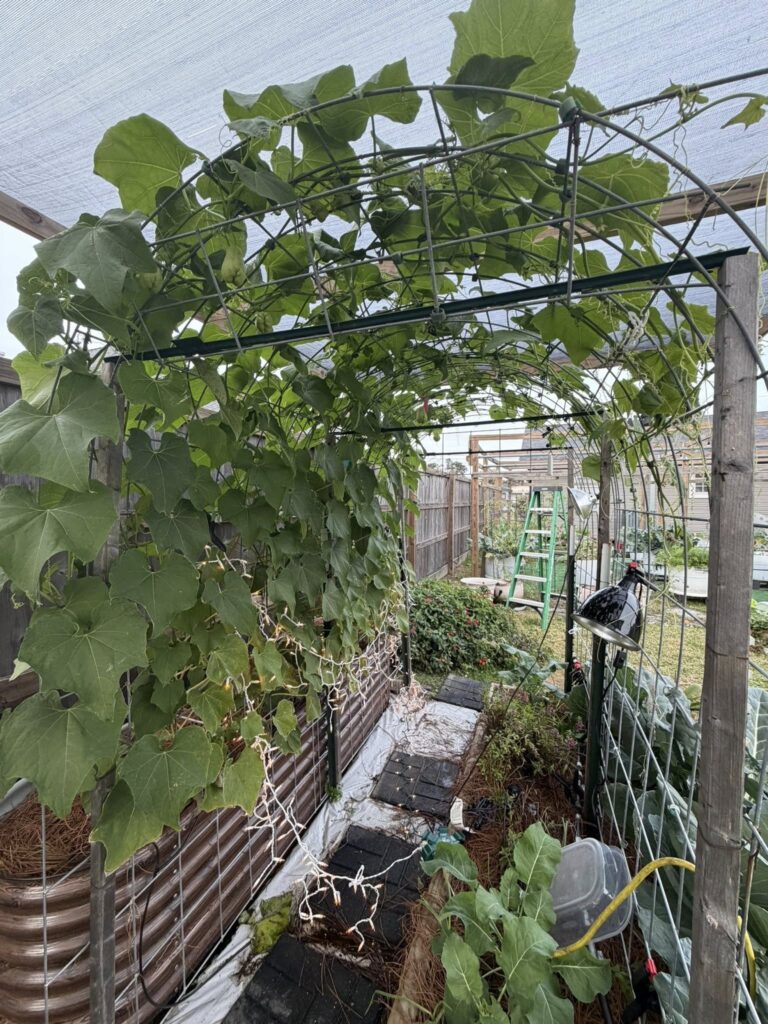
Michelle Glore’s raised bed with a silver plastic moisture barrier beneath it.
Noah couldn’t do it, nor can we, but Michelle Impastato Glore invented a brilliant idea: use a raised bed with a moisture barrier to overcome a saturated yard.
The Outcome: She planted a new mirliton in September in the raised bed in her water-saturated yard, and four months later, in December, she harvested mirlitons!
The problem with raised beds is that when the soil beneath them becomes saturated, the bed won’t drain. It’s a scientific principle that fluids will always flow from an area of higher pressure to an area of lower pressure until equilibrium is reached. That means that when the garden soil is flooded, the moisture in the raised bed won’t flow downward.
In the past, we recommended drilling holes in the raised bed above the soil line to allow moisture to flow laterally. That works, but Michelle installed a plastic barrier under the raised bed, which accomplishes two things. (1) It prevents ground moisture from leaching upward into the bed when the yard is saturated, and (2) it allows excess bed moisture to flow out through the cracks at the base, where there is no pressure.
If your tall raised bed has horizontal holes and a plastic moisture barrier beneath, it creates two outlets for bed moisture to escape: the horizontal holes and the crack at the base of the bed. The moisture will drain more rapidly, stabilizing soil moisture, which is ideal for mirlitons.
Moreover, the bed does not constantly leech up ground moisture.
If you already have a raised bed, consider switching to a plastic moisture bed now, before you plant. All you have to do is temporarily remove the soil from the bed, install the plastic beneath the bed structure, and then refill the bed. Make sure the plastic extends beyond the bottom edges of the bed structure. If you don’t already have them, drill a few holes in the bed, a few inches from the base, for lateral drainage.
Here’s a video of Michelle’s moisture-protected raised bed and the vine she planted in September that produced only four months later.
How Mirliton Sprouts Root When Containerized
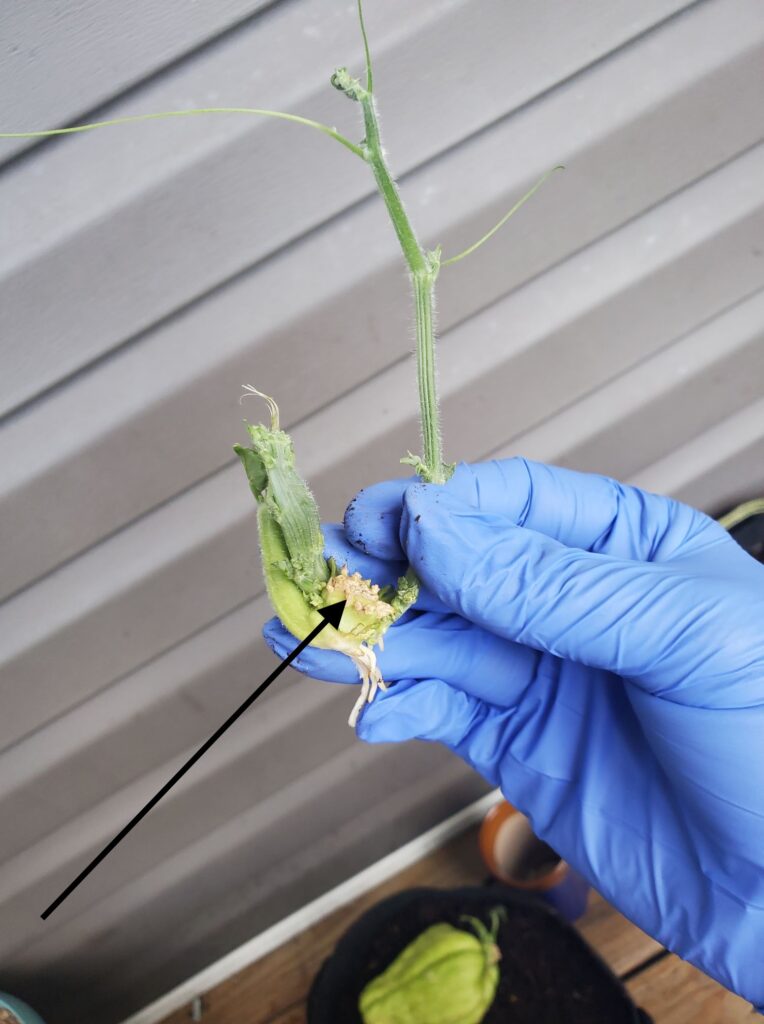
Young mirliton sprout removed from the container. The arrow points to the plant radicle (rooting organ)
The photo shows that although the root radicles (white, bumpy protuberances at the top) are pointing upward, yet the roots themselves have begun to grow downward into the soil. The radicle is the embryonic root of the plant, and in this case, even though it was planted mostly above the soil line, it immediately sent roots downward to absorb water and nutrients from the soil. So even if you plant the seed upside down, the roots know which way to grow. That’s why mirliton sprouts generally succeed, regardless of whether they are planted “large end up” or “large end down.”
Using a Bamboo Stake to Measure Soil Moisture
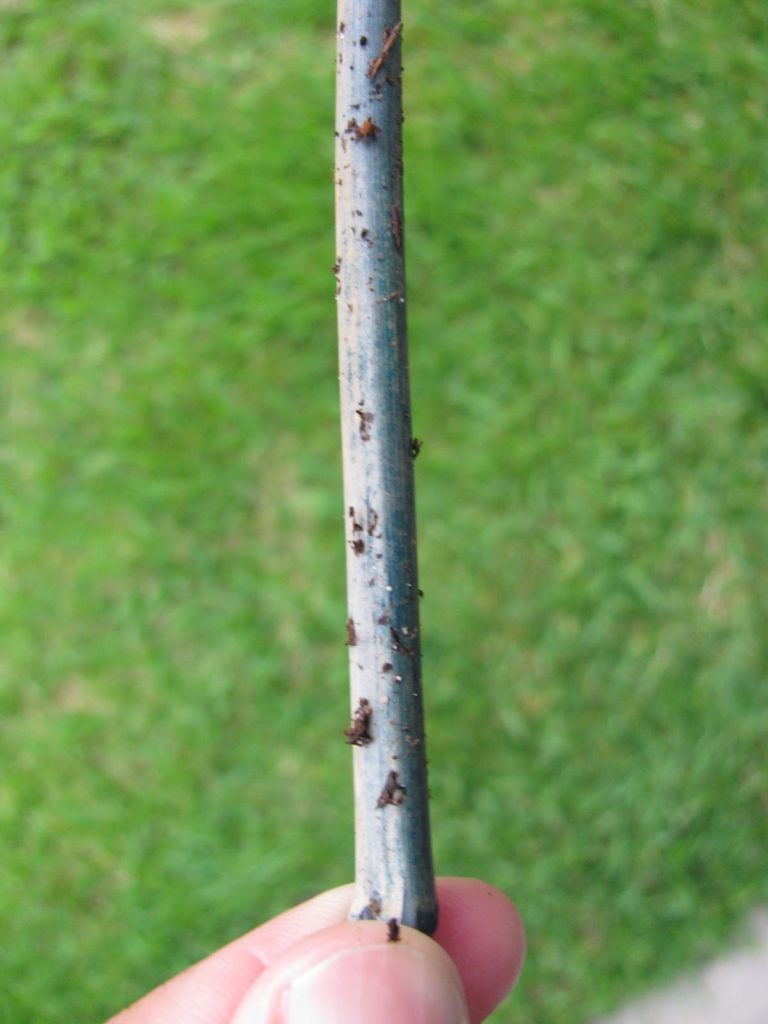
Evenly distributed flecks (crumbs) of soil indicate good soil moisture at all root zone levels. No need to water.
An old tomato stake can be used to measure soil moisture and prevent waterlogging. We generally recommend using a metal soil sampler, but the bamboo stake will work in a pinch. Click on each photo in this link to read the instructions about how to use it. Click here how to use a metal soil sampler.

Buyer Beware!
It’s that time of the year when desperate gardeners in search of an Heirloom Mirliton see one at a garden store and snatch it up. But garden stores are notorious for selling mirliton plants without naming the variety or grower. They may well be an authentic Louisiana heirloom variety, but if you buy from a garden store, eBay, or Facebook Marketplace, you are taking a risk. That’s why we advise people to only purchase seed and plants from members of this group because we verify that they are selling authentic, certified heirlooms.
But, if you buy from a garden center, we recommend checking the plant label to confirm it is a named Certified Louisiana Heirloom Variety. All the named varieties are in the post below. If the label says it’s an “unnamed variety”, ask the store owner who sold them the seed. You will also find a list of all the people growing and selling unnamed varieties in the post. If it has no label and the store owner won’t tell you where they got it, turn around and go home.
We are the only organization in the U.S. that certifies heirloom mirlitons, and we do so to ensure people receive a variety that grows well in our region.
See the list of named varieties and the list of people selling unnamed varieties here.
Search Before You Post! (For those looking for Heirloom Mirlitons)

FOR THOSE LOOKING FOR HEIRLOOM MIRLITONS: PLEASE READ BEFORE POSTING
By David Hubbell
How to Get a Crop Next Spring With the Mirliton Sprout You Have Now.

How can you get a spring harvest from a newly planted mirliton?
Try a little Wizardry–trick the sprout!
We learned last year that people who plant fall sprouts in containers can get a crop as early as the next spring. How did they do that? They made the sprout think it had been planted in the ground for several months.
Here’s how it works:
The reproduction clock on a mirliton starts the day it senses that it’s in soil. Then it will flower and fruit 110 days later.
Do the math.
If you container-plant a sprout in November and then transplant it into the ground in March, it has been in soil for 110 days by the following May. That’s why so many people who container-planted their fall sprouts last year got a small spring crop.
That won’t happen if you use the old method of overwintering your sprouts in paper bags underneath your sink. No soil, no reproductive clock.
An academic scientist did not discover this trick. Mirliton growers discovered it.
Congratulations!
Normally, newly planted mirlitons don’t flower and fruit until the following fall. But if you overwinter them in a container, they will develop a strong rootball to help them thrive once transplanted, and you will likely get a spring harvest as well as a fall harvest.
So, plant that sprout in a 3-gallon plastic or cloth container and get ready for both a spring and a fall crop!