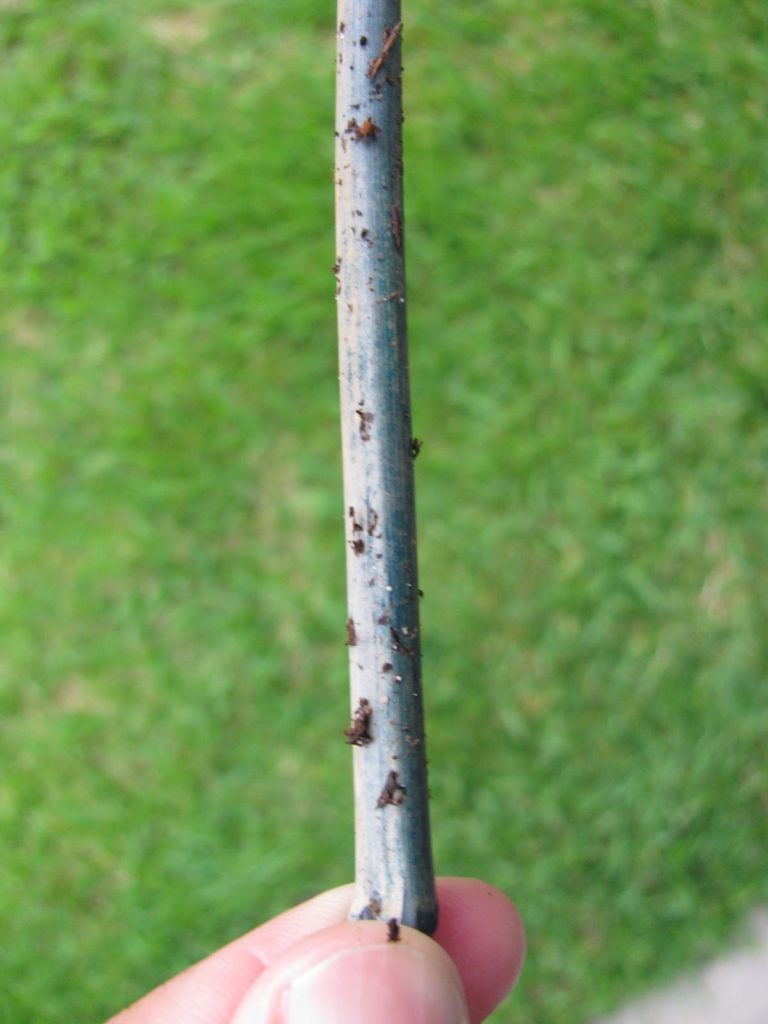
Using a Bamboo Stake to Measure Soil Moisture

by | Dec 19, 2025 | How To, Mirliton, Uncategorized | 0 comments

A smeared, muddy stake would indicate the plant is over-watered. But, evenly distributed soil flecks (crumbs), as shown in this image, indicate ideal soil moisture across all root-zone levels, and the plant needs no water.

An old tomato stake can be used to measure soil moisture and prevent waterlogging.  Use the simple “sight and touch” with the stake before you decide to water your vine.

You thrust the stake into the soil about 8″ and quickly pull it up and examine it. If it’s smeared and muddy, the soil is saturated and needs no water. If it’s relatively dry and flaked with soil, the soil moisture is ideal. If it comes out clean, run it through your fingers and see if you can feel any moisture—if not, then definitely water the plant.   Although the appearance of the soil on the stake is important, running it through your fingers to sense the soil moisture can be more useful.

Click on each photo in this link to read the instructions about how to use a bamboo stake to gauge soil moisture.

We generally recommend using a metal soil sampler, but the bamboo stake will work in a pinch.   Click here how to use a metal soil sampler.

Recent Posts

Checklist for Transplanting a Containerized Mirliton Plant

  Checklist for Transplanting a Containerized Mirliton Plant ✔ Harden off the potted plant before transplanting--or erect a shade cloth for the first week ✔  Plant in fast-draining,  composted soil ✔  Add manure or slow-release fertilizer ✔ ...

Vineguard: Protection From Sun, Rain, and Frost.

  Here’s an idea. Design an arched trellis structure to protect mirlitons from excessive rain, solar radiation, and cold. I call it a Vineguard. It can be used to shunt rain away from the beds, shield the vine from intense heat, and protect it from frost. ...

How to Prune Back a Mirliton in a Container

Although we recommend trellising mirliton vines while they are in 3-gallon containers, some people prefer to prune them back. Pruning is safe and will result in a compact, bushy plant.   The most important point is that when you prune, leave at least three plant...

Lightweight Frost Protection: The Glore System

Growing mirlitons can be physically challenging for people like me, who have health or age problems that limit our ability to get around. Putting up frost protection can be a real headache.   Michelle Impastato Glore invented a solution: She uses lightweight...

Buyer Beware! How to Sell and Buy Mirliton Seeds, Sprouts, and Plants

  The Mirliton.Org Facebook group serves as a market for people to sell or gift mirliton seeds and sprouts. We want to ensure that only viable seeds are transferred so that people are guaranteed a successful growing experience. We don’t want to mandate standards...

How to Rescue a Raised Bed From a Flood

Noah couldn’t do it, nor can we, but Michelle Impastato Glore invented a brilliant idea: use a raised bed with a moisture barrier to overcome a saturated yard. The Outcome: She planted a new mirliton in September in the raised bed in her water-saturated yard, and four...

How Mirliton Sprouts Root When Containerized

 The photo shows that although the root radicles (white, bumpy protuberances at the top) are pointing upward, yet the roots themselves have begun to grow downward into the soil. The radicle is the embryonic root of the plant, and in this case, even though it was...