by Lance Hill | Mar 6, 2019 | Mirliton
Gary Elvis Dugas’ Mirliton Vine in Lafayette, Louisiana
By Lance Hill
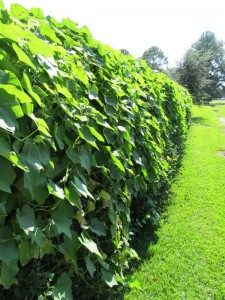
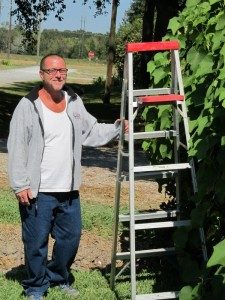
Gary Elvis Dugas has this beautiful mirliton vine growing in Lafayette. He purchased the seeds for Marcus Descant, The Urban Naturalist in the same town.
He kept the seed in paper bags and, when sprouted, planted them in 2-gallon containers February. He kept them and in a greenhouse then slowly brought into sun to avoid sun burn. They were transplanted into raised beds that are about 8 years old, and composted with chicken manure, leaves, and grass clippings. There is a nine-foot hog wire fence surrounding the raised beds to keep out critter. He then covered the beds with an overhead trellis made from 6” X 8” mesh fencing. He uses Miracle Grow Regular in April, June, and August.
Notice that the vine grows on chicken coops, so there is abundant natural fertilizer. Many growers have great success using chicken or rabbit manure mixed into planting holes and then applied to top once a year. That would make it a slow-release fertilizer that mirlitons need. Gary plans to cut back the plant for the winter and then hopes for a larger crop next year. He has picked several hundred this year.
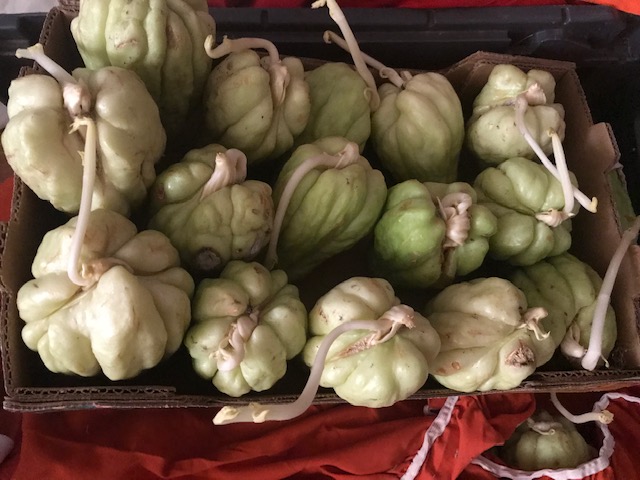
Lafayette Variety Mirlitons sprouting
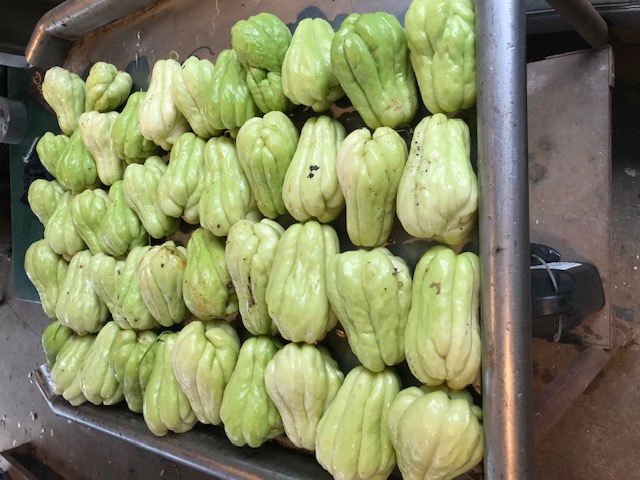
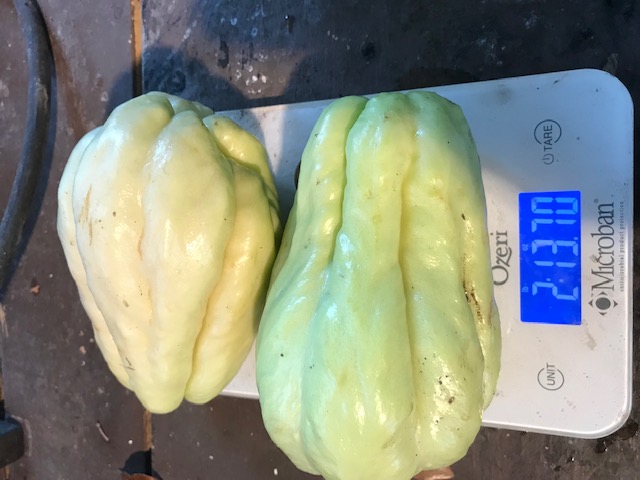
About 24 ounces each
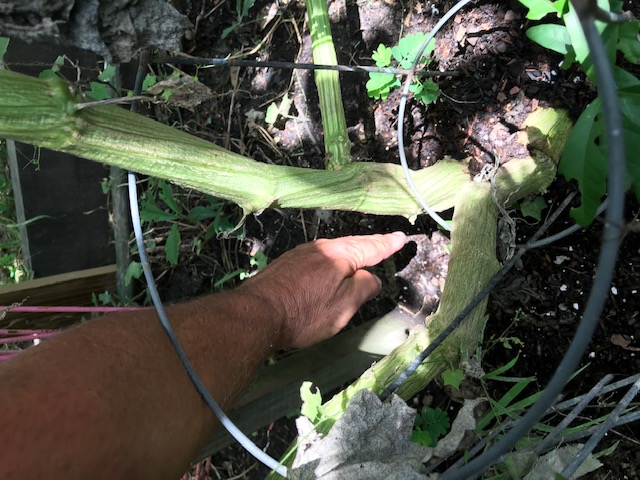
Root base of one-year plant
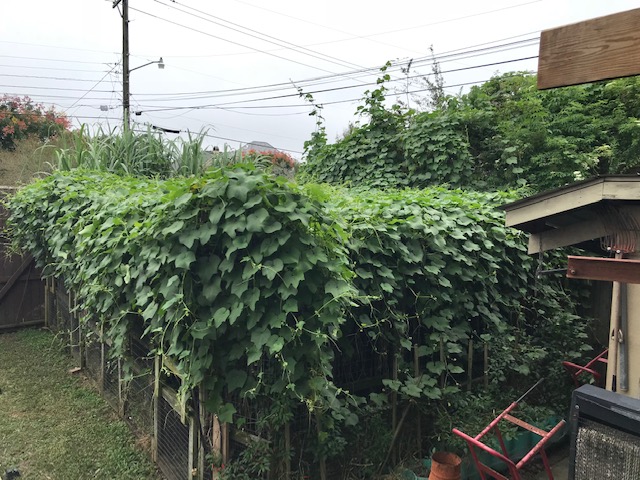
Vine on Trellis over chicken coop
by Lance Hill | Nov 10, 2018 | Mirliton
The Mirliton Man of Mobile Alabama
This blog entry is by David Hubbell. It tells the story of his efforts to grow mirlitons in the Gulf coast South. We welcome other growers to send in their stories, growing methods, and photos of the varieties they are growing. You can reach him by sending me an email at Lance@mirliton.org)
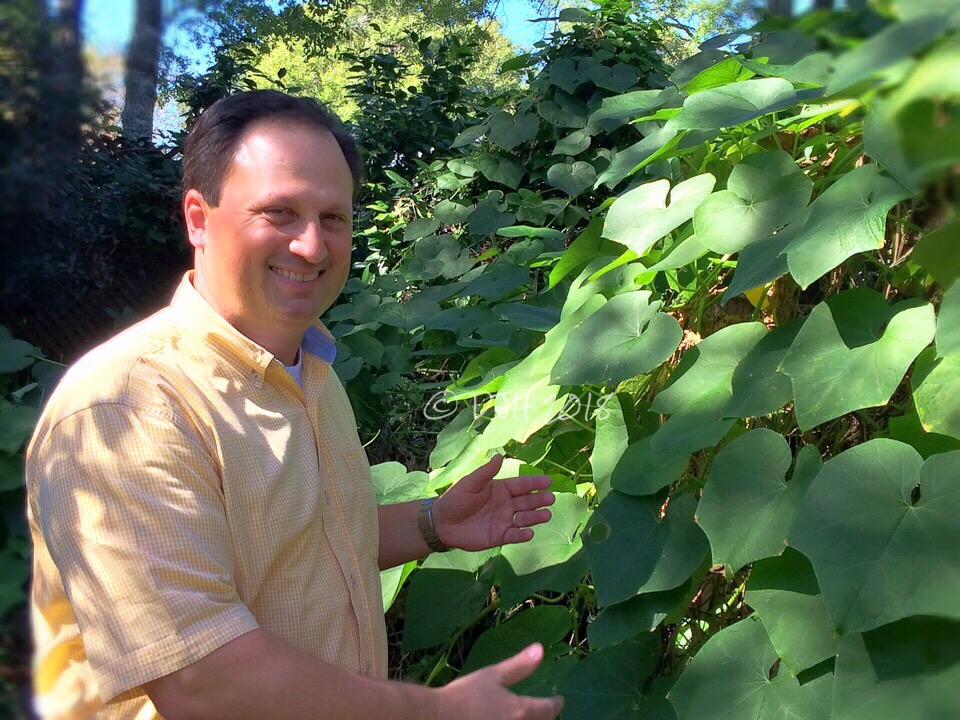 David Hubbell with his Boudreaux-Robert heirloom mirliton variety.
My Mirliton Story by David J. Hubbell
Part I – Initial Attempts
Since my early teens I have been fascinated with my Louisiana ancestry. I learned early on that I am descended from the Germans and French that arrived in the early 1700s, as well as the Acadians that settled in St James Parish in 1765. Despite this long pedigree, I have never actually lived in Louisiana for any appreciable amount of time. After marrying and settling down in Mobile, it became one of my goals to create a Louisiana garden at my home in south Alabama. One of the items I started trying to grow back in 2006/2007 was mirliton (AKA chayote squash or vegetable pears).
I scoured the internet for where to acquire the seeds and how to grow it. Well, I learned in short order from the LSU AgCenter site that one doesn’t extract the seed, but simply set the fruit or seed mirliton in a cool, dark place wrapped in a paper bag and within a few weeks, you should get roots and a vine will start. Now the question was “where to get it?” According to some folks who grew it in California, I simply needed to find a grocery store that sold them and plant those. So now I had a mission. Where to find one? Well, I really had to go no further than my Mom (don’t they always have the answers?) She mentioned that she had seen them at several of the local grocery stores, in particular a large one stop megastore. Now I should add at this point that as a kid growing up in Texas we rarely ate these. Similarly, on visits to Metairie, Louisiana at Christmas, I never was interested in trying mirliton. Therefore, I had a twofold challenge: 1) figuring out how to grow them and 2) how to eventually cook them. So off I went and lo and behold, I found them for about $1.29 apiece. Well, even though I rarely had seen them, my memories from my childhood and the images from my research didn’t quite match the ones I had found. Most of what I saw looked pretty close, but it was more of a “snubbed nose” version. The sticker on them indicated they were a product from either Mexico or Costa Rica. I found 3 that closely resembled the images in my head, purchased them, and then brought them home. I then promptly followed the directions from the good folks at LSU and within a few weeks’ time, I was delighted to see that two of the seed mirliton had roots and vines were emerging. This was around December and by late February; I planted the two into the ground next to a very ornate trellis I bought for them to grow up. I had some conversations with my Pepere (grandfather in Louisiana French) who had grown them a while back and he mentioned to be careful where you plant them. I believe he mentioned having them too close to a tall oak and having to use a ladder to get the fruit. As a result, I tied a rope between my trellis and a large oak in my back yard, which was around 30 feet away. Well the first year, the vines emerged and started to grow. They grew all spring and summer and while they didn’t get quite as long as the information from LSU indicated, I figured it was due to them being young (FYI these vines will come back year after year if protected from the freezing weather). Well in addition, I finally started to see some male and female flowers on the same vine; however, it was now early September and I had read that one should be harvesting them from late September until late November (or until freezing weather hits). Eventually some small fruit did appear, but they never seemed to get much larger than a raisin and by then, freezing weather arrived in south Alabama. So, my first attempt turned out not to be a fruitful one.
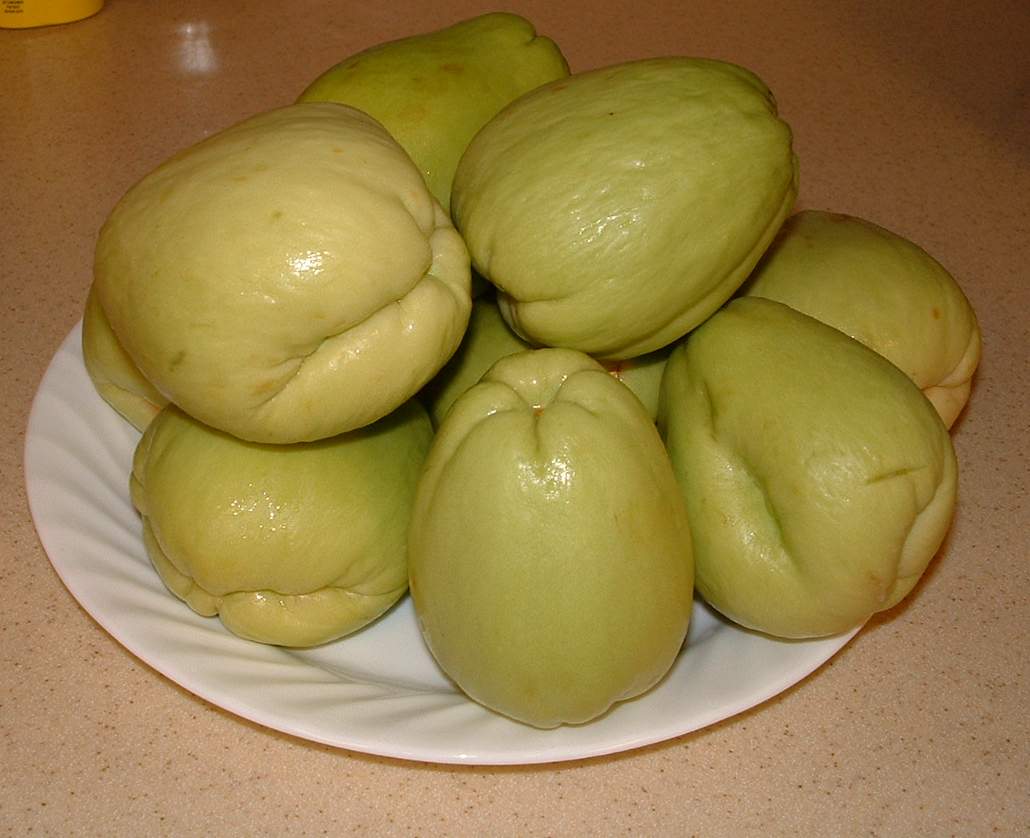
Store bought Mirliton
Despite not producing any fruit, I had actually gained quite a bit of knowledge on how to start these plants and what to look for. So as December of 2007 approached I cut back the vines and covered up the root system in preparations for them to come back. In addition, I also bought 3 more seed mirliton to propagate. Well, these fruit also successfully started to root and produce a vine. In the meantime, spring finally arrived back in south Alabama and I was pleased to see the mirliton vines from the previous season were coming back. This time the vine grew and grew and grew, reaching the 50+ feet I had read about. In fact, it climbed the trellis, the rope, and up the tree, about 20 feet above my head. Surely with such phenomenal growth, this vine would flower earlier this year and I would succeed in getting fruit. Well, it did start to flower early in September and had a lot of small fruit on the vines, but for some reason, they still never grew beyond the size of a large raisin. Well, the freeze came and I had to cut the vine back. I now was questioning the location I had chosen to plant my mirliton vine. Since my yard is partially shaded, I figured it might have something to do with that. Thus, in December of 2008, I repeated the same ritual of the past two years and started some more vines. The following February, it turned that the original vines I planted weren’t going to come back. One appeared to have a fungus and rotted the root structure, the other just never emerged. So, into the ground went two new plants. Same growing pattern as the year before, however this time with a lot of flowering earlier and one mirliton on its way to full maturity (as opposed to 50-100 reported each vine should bear). I had also noticed the squirrels in the yard had developed a taste for the vine and apparently the small fruit. To remedy this, I put up a lot of bird netting to tangle them up. On Thanksgiving Day, this mirliton was now up to the size of a walnut and I was ecstatic. I woke up on Black Friday morning to go somewhere and as I was pulling out of the driveway, I spied something light green on the ground. No! It couldn’t be! It was!!! My one chance at a mirliton lay on the ground with… teeth marks from a blasted squirrel. So here it was 3 years of trying and not a single mirliton.
Part II – The Mirliton Man and Mr. Boudreaux
I was about ready to give up when I came across a Times-Picayune article discussing someone in New Orleans they called the Mirliton Man (Dr. Lance Hill) and his Adopt-a-Mirliton program. Upon reading his interview it turned out that he discovered that the mirliton vines that had once been a common fixture in backyards in the New Orleans area had all but disappeared due to Hurricane Katrina and the effects of the salt water as well as perhaps a lack of interest in growing them.
The article about the Mirliton Man also revealed that those local farmers in the area who grew mirliton for a living were also greatly affected by Katrina. Since they didn’t have any surviving vines or fruit, they started to plant the ones from Costa Rica and Mexico, but weren’t having too much success. It appeared that these varieties needed a lot more chemical fertilizers to keep them going in Louisiana. That is when he started his Adopt-a-Mirliton program to try to see if he could get some seed mirliton from those surviving south Louisiana vines and help jump start the mirliton production. That is when the light bulb went off in my head. I bet all of my issues had to do with variety and not necessarily the technique or partial shade. I tried to contact him to find out where I might try to find some of these types of mirliton, but was unsuccessful in getting up with him. In the meantime, my Mom mentioned that my late Pepere’s good friend had been growing these in Metairie for years. Well, she asked my uncle to see if he could get in touch with him and find out if he had any mirlitons during the Fall of 2009. Turns out he did and was able to give us 10 seed mirlitons.
These mirlitons definitely had a different shape than those I had been trying to grow. They were more pear shaped, had some deep creases, and a few tiny spikes on the bottom. The goal had now become to try to grow and propagate these to see if we could start a new crop in south Alabama. Of the 10, only 4 developed a vine. I then suggested that my Dad plant 2 in his yard in Fairhope and I plant 2 in Mobile. His yard had a lot more room and sunlight, so if that had been a factor, surely this will eliminate it. Well since these 4 had well developed vines by Valentine’s Day, we decided to replant them in pots until we could get them into the ground. As it turned out, by March only one vine survived. We planted that into my Dad’s yard and hoped for the best. Then throughout the course of the year, I would ask my Dad several times a month (if not weekly) how the vine was doing. In addition, I would go check it out whenever we would visit. As the Fall 2010 approached I started inquiring about the flowers. Around late August, he mentioned it appeared to have some small buds starting and upon a subsequent visit, I confirmed they were both male and female flowers on the vine. With a few weeks he started to see a dozen mirliton growing. To say I was pleased would be a bit of an understatement. It finally looked like we would get some mirliton after 4 years of trying. After Thanksgiving Day, I took a few days off and my Dad and I were debating on going fishing. A cold front was moving in and between the wind and rain we decided it would be better to just prepare the mirliton vine for the freeze. He and I went into the back and started to pick the mirliton. Well, the more we worked our way through the leaves and vines, the more mirliton we found. In no time at all, we had surpassed the dozen Dad had seen. In fact, the 5-gallon bucket he brought out started to overflow. After about an hour, we counted up what we had 65!
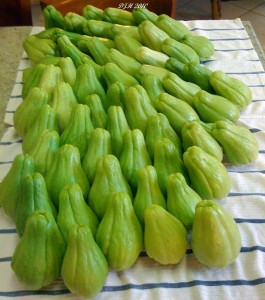
65 Mirlitons Harvested from a single plant.
We were in disbelief. I had read how these vines can produce between 50-100 and here we were within that range. In addition, there were still another dozen or so smaller ones we left to continue growing until a freeze came. After we brought them in and cleaned them up, we set them on the counter. Now we had an even bigger dilemma. How were we going to possibly cook so many?
Anyway, it has been close 10 years since that first successful harvest. I am happy to report that I was able to start some seed mirlitons in pots the following January and in the Fall of 2011 had my first fruitful harvest of mirliton in my yard in Mobile. I planted three of these Louisiana Heirloom Mirliton in my yard and today one of these is still alive and thriving. Since that time, I am happy to report that I have been fortunate enough to get in contact with Dr. Hill and we have established that the variety I have been growing were similar to some he had studied but didn’t quite match any of them exactly. From our initial correspondence and subsequent conversation, he indicated I could name it mine as I saw fit, so in honor of my Pepere’s friend whom I received the initial seed mirliton I have named it the Boudreaux-Robert mirliton (the origins on where Mr. Boudreaux got it will have to be told in another post). Since 2010, I have tried over a dozen different mirliton recipes, shared close to 25 mirliton seedlings with family and friends, and created lots of great memories sharing the story of the miriton with folks here in south Alabama. Growing mirliton represent more to me than just growing something to eat. Doing so helps to keep me connected to my Father and Pepere, who have both passed since I started this adventure in 2006, my Louisiana heritage as well as learning, sharing, and helping preserve one of south Louisiana and the Gulf Coast’s most iconic and endangered vegetables.
H



Recent Comments