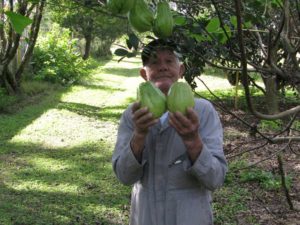
(Joseph Boudreaux with his home-grown mirliton variety)
Part of the inspiration for forming Mirliton.Org was the impact of Hurricane Katrina on New Orleans the the Louisiana coastal parishes. Mirliton plants will die if the roots are submerged in water for more than 48 hours: The Katrina flood destroyed all the vines in flooded areas in New Orleans and some coastal parishes.
To renew the tradition of backyard mirliton growing, we had to find traditional heirloom mirliton varieties grown outside New Orleans. The mirlitons sold commercially in grocery stores (as Chayote) could not be used as seed: they are largely imported from high altitude sites in Costa Rica and Mexico and although they will sprout and grow a few stems, like many high-altitude plants, they normally succumb to our unique growing environment and plant diseases.
Since 2007, we have searched for growers of what we call traditional “Louisiana heirloom mirlitons” by advertising in the Louisiana Department of Agriculture publication “Market Bulletin” and contacting Parish (county) Agricultural Extension Service staff–thanks to the assistance of the Louisiana State University extension service. We also simply drove the roads along the bayous where mirlitons were traditionally grown on bayou banks (that’s how we found the Mister Rock mirliton variety).
We eventually found growers who had been growing the same variety for decades, although they are few and far between and a disappearing breed. With the discovery of these growers–most of them older gardeners in their eighties who were upholding a family tradition of mirliton growing, we knew now that the traditional locally-grown varieties would once again thrive in New Orleans and rest of the state.
These growers would donate seed mirlitons to re-seed New Orleans and, as the demand grew, we would also buy from growers and give away the seed as sprouts and plants. As word spread of our project (which began under the name “Adopt-A–Mirliton”), we ended up distributing seed throughout Louisiana, Texas, Mississipi, and Alabama. We decided to feature some of the success stories on this blog from time to time.
In 2010 a reader of the Market Bulletin called me and said he knew of a grower in Broussard, Louisiana who had several vines of the same variety that he had been growing for decades. I visited Joseph Boudreaux in Broussard and he donated a few of his mirlitons and I purchased several more. Later, after an early freeze, he donated a few dozen freeze-damaged fruit that he assured us would germinate and grow: he was right.
We always name the variety after the person we first found growing it so that we can track the variety’s progress as we distribute it throughout the region; heirloom varieties have different qualities that we are testing for, such as fruiting habits and disease resistance. Naming the variety also allows us to find new growers who will “adopt” a specific variety and commit to growing it so that we will always have a reliable seed source and can preserve the genetic diversity of the locally grown varieties.
In 2011, Mirliton.Org donated three container plants of the Joseph Boudreaux variety to Sun Harvest Garden in New Orleans on Oretha Castle Haley Boulevard. A small Central City community garden built on a cleared lot, Sun Harvest is run by Pam Broom, a long-time community activist and urban farming advocate. Planted in the spring of 2011, the vine produced a small crop later that fall. During the warm winter of 2012 (we never got a frost in central New Orleans), Pam harvested even more fruit and the plant is still producing during the traditional spring crop cycle.
Pam has distributed some of the the new fruit as seed to other gardeners in the area and her vine is, as mirlitons are inclined to do, rapidly taking over more of her garden. But she’s happy with the prolific new arrival. “One of the things that inspires me most about receiving mirliton plants from Mr. Joseph Boudreaux,” says Pam, “is that thanks to him, I am experiencing growing a beautiful, sweet and delicious variety in the heart of the City of New Orleans.”
From Broussard to New Orleans: mirlitons are making a comeback thanks to people who appreciate this iconic Louisiana plant.

Pam Broom with her Joseph Boudreaux mirliton variety vine at the Sun Harvest Garden in New Orleans
Lance Hill
Mirliton.org