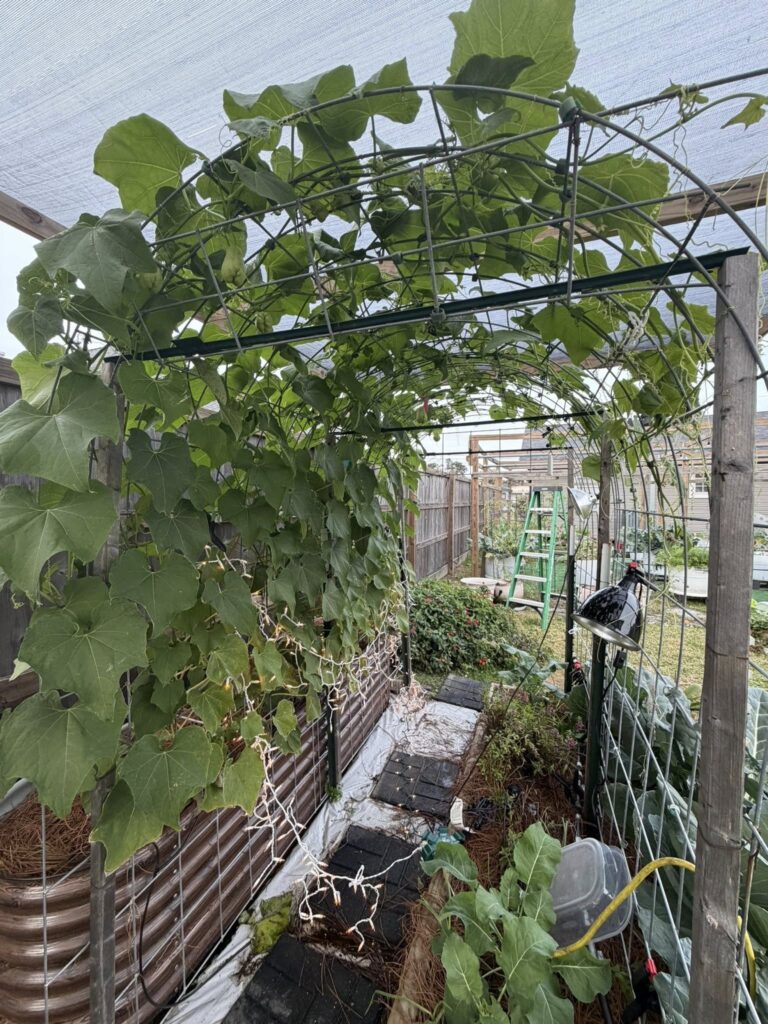
Michelle Glore’s raised bed with a silver plastic moisture barrier beneath it.
Noah couldn’t do it, nor can we, but Michelle Impastato Glore invented a brilliant idea: use a raised bed with a moisture barrier to overcome a saturated yard.
The Outcome: She planted a new mirliton in September in the raised bed in her water-saturated yard, and four months later, in December, she harvested mirlitons!
The problem with raised beds is that when the soil beneath them becomes saturated, the bed won’t drain. It’s a scientific principle that fluids will always flow from an area of higher pressure to an area of lower pressure until equilibrium is reached. That means that when the garden soil is flooded, the moisture in the raised bed won’t flow downward.
In the past, we recommended drilling holes in the raised bed above the soil line to allow moisture to flow laterally. That works, but Michelle installed a plastic barrier under the raised bed, which accomplishes two things. (1) It prevents ground moisture from leaching upward into the bed when the yard is saturated, and (2) it allows excess bed moisture to flow out through the cracks at the base, where there is no pressure.
If your tall raised bed has horizontal holes and a plastic moisture barrier beneath, it creates two outlets for bed moisture to escape: the horizontal holes and the crack at the base of the bed. The moisture will drain more rapidly, stabilizing soil moisture, which is ideal for mirlitons.
Moreover, the bed does not constantly leech up ground moisture.
If you already have a raised bed, consider switching to a plastic moisture bed now, before you plant. All you have to do is temporarily remove the soil from the bed, install the plastic beneath the bed structure, and then refill the bed. Make sure the plastic extends beyond the bottom edges of the bed structure. If you don’t already have them, drill a few holes in the bed, a few inches from the base, for lateral drainage.
Here’s a video of Michelle’s moisture-protected raised bed and the vine she planted in September that produced only four months later.