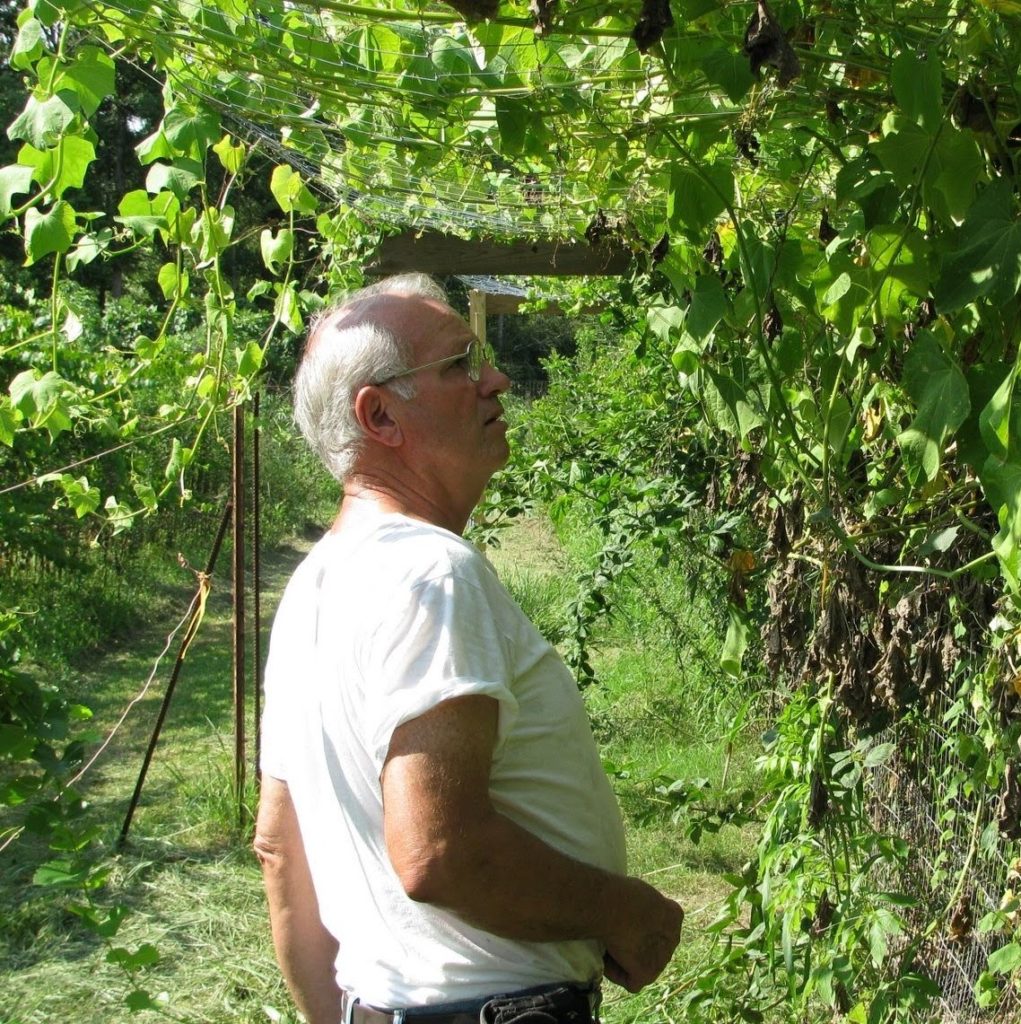
Ervin Crawford And his Mirliton Vine
In 2008, I was searching for a Louisiana heirloom mirliton to replace the variety I had grown since 1983. The hurricane Katrina flood had killed almost every mirliton in New Orleans. The usual suspects had given me all the normal bad advice: “Buy one at the grocery store. A mirliton is a mirliton. They’ll grow fine.” Nope. I planted, they died; I planted, they died. Over and over.
After a little research, I discovered there were scores of varieties—perhaps hundreds—each adapted to the particular climate and altitude. I had to find the one traditionally grown in Louisiana. I discovered that the Louisiana Department of Agriculture’s monthly Market Bulletin was digitally archived years back. I went through it looking under “fruits and vegetables for sale” and saw one name repeatedly; Ervin Crawford, Pumpkin Center. It was a long shot because the advertisements were decades old, but I called the number. Ervin Crawford answered.
I immediately drove to Pumpkin Center and met him. On that first visit, Ervin gave me about 20 mirlitons and with those 20 plants, I started Mirliton.Org. Ervin played a crucial role in saving the Louisiana heirloom mirliton.
Visiting Ervin’s farm is a pilgrimage everyone should make. He’s a retired airline mechanic and knows more about mirlitons than anyone I know. He has been growing them for five decades, first in Peal River where he was raised, and later in Pumpkin Center where he bought his 20-acre retirement farm. He grows everything; pecans, figs, beans, berries, bees, chickens.
He has a quality found in most successful gardeners–a healthy curiosity. He wanted to know why he had success as well as failures. And failure and mirlitons often go together in the poor sandy pinewoods soil of the area called the Florida Parishes. I have heard people in the region say, “They won’t grow up here.” At first, I thought that they were using the wrong variety, or planting them incorrectly. Ervin taught that the problem was not the soil, it was what was beneath the soil.
Soil sample tests tell you a great deal, but they won’t tell you what you need to successfully grow mirlitons. Mirlitons are shallow-root plants and they sink or swim depending on subsurface drainage. If the soil doesn’t drain quickly enough, the roots can’t absorb oxygen, and the plant founders or dies. Building a raised bed on top of poorly-drained soil may result in a mud boat. The bed has to have an outlet to either absorb or remove excess water. So to succeed, you need to know the geology and history of the land you are gardening on–and Ervin asked the right questions when he first got to Pumpkin Center.
Ervin learned that Pumpkin Center’s soil was considerably different from Pearl River, where he had learned gardening. Pearl River was a loamy basin soil, rich and porous. In contrast, Pumpkin Center was in the middle of the great Piney Flats that stretches from Florida to Texas. It was notoriously bad poor soil—sandy and acidic. When he once had some excavation work done, he saw that solid white clay lay a few feet down–a real barrier to drainage.
I realized that I had never asked those questions about where I was gardening. To grow mirlitons, you have to be part geologist, hydrologist, and historian. You don’t have to become an expert; just enough knowledge to benefit your mirliton.
As I learned more about the history of where I was gardening, I realized that my mirlitons had often thrived in spite of me. I never once had asked what was under that topsoil or what was there 100 years ago.
I do now, thanks to Ervin.