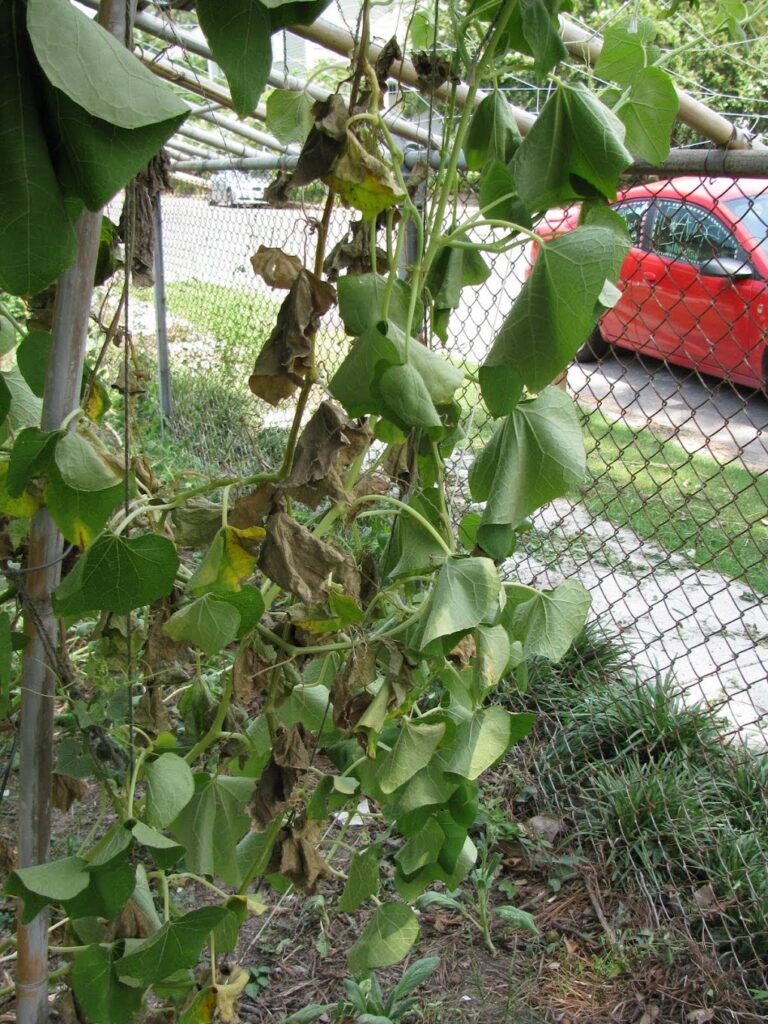
Sudden wilt and dead leaves caused by anthracnose.
Anthracnose is a summer disease caused by many fungi, but the pathogen that affects mirlitons is Colletotrichum orbiculare. For the purposes of this article, I will call Colletotrichum orbiculare the “anthracnose fungus. It is a chronic problem with mirlitons, and it’s the main reason plants die in the first year. There is no known synthetic or biological fungicide that can prevent or eradicate anthracnose in mirlitons, although Mirliton.Org is testing some new biofungicides.
But anthracnose is like a sprained ankle; you can’t prevent it or take a pill to cure it, but you can minimize the risk of getting it and speed up the healing process.
Anthracnose and powdery mildew (PM) are fungal diseases that start with a common sign: leaf yellowing (chlorosis). It’s important to recognize the difference because powdery mildew can be treated, while anthracnose can’t. The PM fungus spreads on the surface of leaves, initially as faded yellow dots and then yellows the whole leaf until it wilts and dies.
Anthracnose, in contrast, grows inside the leaf cells and spreads cell-to-cell (intercellularly), so it tends to spread between the leaf veins and form sharp wedges. It kills the tissue within the wedge, spreading across to the whole leaf, so you will see both yellow and brown tissue in the same wedge photo.
The anthracnose fungus also penetrates the stems, leaving brown lesions on the surface that emit a gummy exudate–another distinctive of the disease. Once inside the stem, it blocks the flow of water and nutrients downstream to the rest of the plant. The “girding” process is why you will see a sudden wilt and death of a stem branch. Brown stem lesions and sudden wilting are key signs that the vine has an anthracose infection.
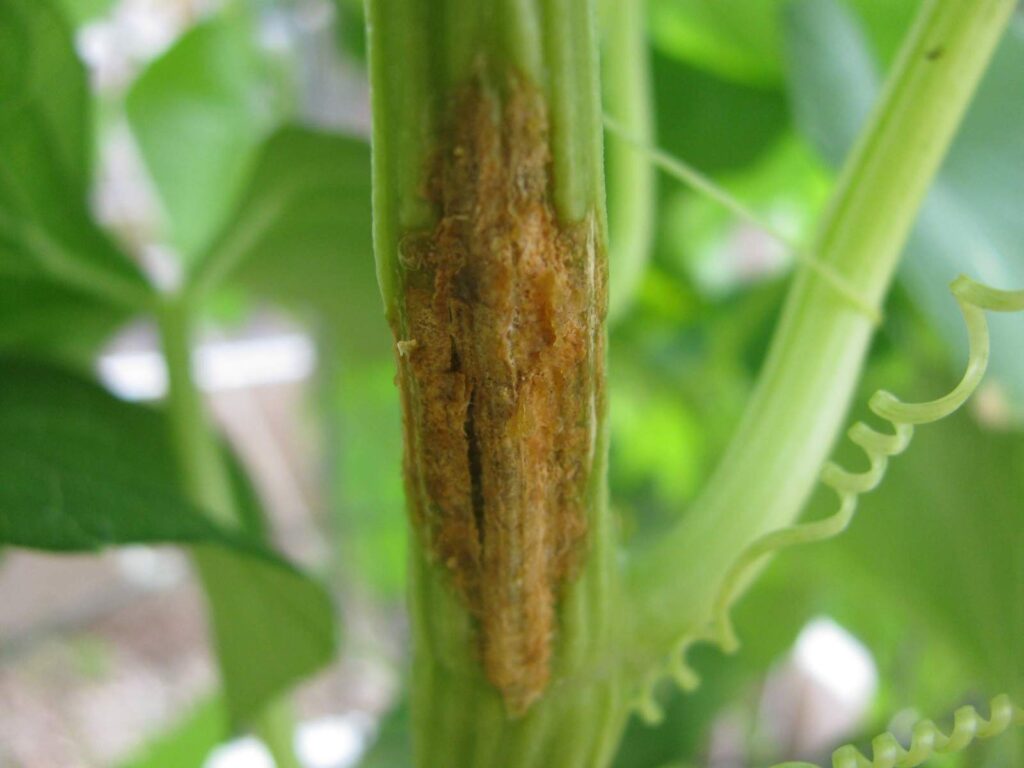
Anthracnose lesion with gummy exudate on the stem.
Mirlitons tend to experience anthracnose epidemics in July and August due to rainfall patterns. Intensive rains splash up anthracnose fungi from the ground onto the plant stem. The fungus incubates during warm nights and produces thousands of spores that are contained in a sticky base. Rainstorms dissolve the sticky film, which releases the spores. Then, raindrops splash the spores to adjacent leaves, and that’s why anthracnose epidemics occur during the hot, rainy season.
The good news is that for every stem lost, a healthy, usually a mature vine, will send up a new shoot. It is a tug-of-war with the disease through the summer, but generally, the disease will disappear by September in time for flowering and fruiting. Additionally, once infected, that mirliton plant will acquire increased resistance to anthracnose every time it gets the disease. So, if your vine develops anthracnose this year, it is less likely to develop it next year. However, first-year plants are more vulnerable and can die from the disease.
The key to surviving an anthracnose epidemic is to have a healthy vine in place before the epidemic. That means a well-drained and aerated vine. When the soil is water-saturated and oxygen is unavailable in the root zone, plants undergo dramatic changes to survive. They are literally in anoxic soil, similar to the dead zones in the Gulf of Mexico. They shift from aerobic to anaerobic metabolism, resulting in only 5% of the energy efficiency found in healthy, aerated soil.
As a consequence, they produce toxic organic and inorganic compounds and deprive leaves of potassium, a crucial element for maintaining leaf functions. After 24-48 hours, the roots have been damaged, making it more difficult for them to uptake water and nutrients. Leaf functions are weakened, and the whole plant is vulnerable to anthracnose and other diseases–and will reduce vegetative growth and fruiting.
The challenge for us is that, unlike most of the U.S.A., well-drained soil is difficult to find along the Gulf Coast. Most of the suburbs and many new developments were built on reclaimed swamps that were filled with soil from local rivers. That soil was never intended for agricultural use, and it drains poorly, has a high water table, and intense rains can quickly saturate the soil, leaving it anoxic.
So, drainage is a key factor in disease prevention.
Solutions: The most reliable way to prevent anthracnose is to protect the roots.
Ground Planting:
Make sure the soil is well-drained and aerated. Plant on your highest available area, use planting hills, and avoid planting near roofs. Plant near a tree if you have one; trees are natural sponges and tend to stabilize soil moisture. If you already have the vine planted, you can dig shallow drainage trenches to remove excess rainfall away from the vine or add a corrugated drain pipe or a French drain.
Raised-bed Planting:
Raised beds are particularly vulnerable to anthracnose and should be avoided if possible. Remember that a raised bed can’t drain into a saturated yard, so you need to construct a bed that will permit excess rainfall to escape laterally through the sides. Add a lateral route for excess water to exit above ground level by drilling 1/4 “ holes along the side panels.
Play the Odds:
Raising one mirliton is tricky, but raising several increases the odds that you will make it through the first year. Mirlitons acquire resistance to some plant diseases over time, so there is a benefit to keeping a plant alive for several years.
Summary:
For now, the best protection against anthracnose is (1) to use only locally grown heirloom mirlitons for seed since they are likely to have some resistance to anthracnose; (2) plant in well-drained, aerated sites; (3) provide plenty of trellis space so leaves on top can spread out and get maximum exposure to the sun (a natural fungicide) and air circulation; (4) minimize leaf/soil contact by using an overhead horizontal trellis at least 4 feet above the soil; (5) remove all dead leaves after an anthracnose infection and dipose of them in a plastic bag; and (6) always irrigate gently with a hose set on low on the surface or drip irrigation to prevent splash-up of soil-borne fungi. Do not water mirlitons from the top down. Once leaves and stems are brown and dead, remove them and dispose of them away from the vine.
Click here to learn the signs of anthracnose.
How the anthracnose fungus works:
Colletotrichum orbiculare is a versatile fungus because it feeds on all kinds of tissue–living or dead. The scientific terms for its mode of parasitic activity are biotrophic, saprotrophic, and necrotrophic, which simply mean it can live off living tissue, dead tissue, or both.
Understanding necrotrophic helps diagnose anthracnose. This means the fungal pathogen will destroy a section of the leaf, turning it yellow, and then consume the remaining section until it is brown (necrotic), effectively eating a hole through the plant. The brown spot on the leaf or on the edges is a reliable indicator of anthracnose. PM, in contrast, is an airborne spore that can deposit at the top of a plant and is not as versatile; normally, the leaf will simply uniformly turn yellow and wilt before dying (necrotic), with paper-like spots and holes appearing.
Click here to see photos of anthracnose infection signs on leaves and stems at different stages (click on each photo for descriptions)
Click here for information on identifying and managing powdery mildew.