Alternaria Leaf Spot/Blight in Mirlitons (Chayote)

by | Jul 1, 2025 | How To, Mirliton | 0 comments

Alternaria Leaf Spot and Alternaria Leaf Blight are two related plant diseases that affect mirlitons (chayote).  The fungus Alternaria cucumerina causes leaf blight, and the fungus Alternaria alternata f. sp. cucurbitae causes leaf spot. 
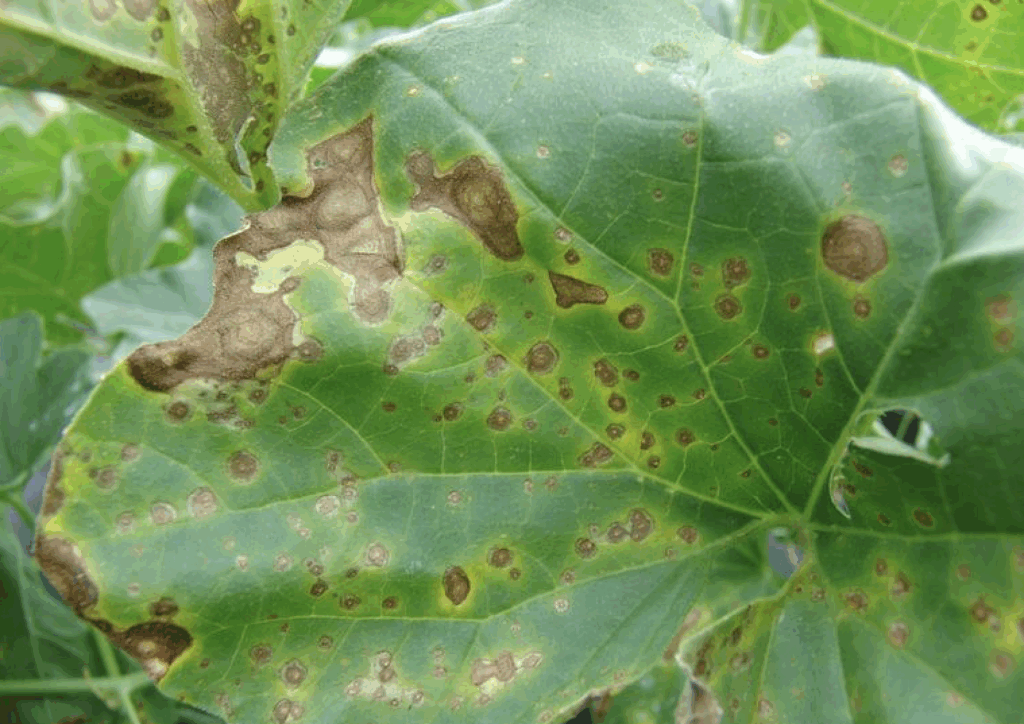
Alternaria leaf spot.

The disease first appears as brown leaf spots with a yellow halo, and as the spots coalesce, they can turn the entire leaf brown (necrotic) and cause it to die. At that stage, it’s referred to as “leaf blight.

Leaf spot starts with concentric black rings that often have a yellow (chlorotic) halo around margins. Although the disease primarily affects leaves, it also causes brown lesions on the stems.  Unlike anthracnose, alternaria does not penetrate the stems and block the flow of nutrients and moisture, so it won’t kill entire shoots and stems as does anthracnose.  The vine will lose leaves, but usually survives the disease and produces in the fall.

There is no known fungicide that can be used to treat it if the temperatures exceed 88℉.  Copper-based fungicides do prevent and eradicate the fungus, but they are phytotoxic in hot weather and can kill the plant.  There are products like Daconil that coat the plant with a film, making it difficult for the fungus to establish itself on the vine. However, it must be applied from spring forward, and there’s no scientific study that indicates it’s effective as a preventative on mirlitons.  Mirltion.Org is currently experimenting with a new biofungicide to test its effectiveness.

Treatment:

Do not water the vine from the top down–that will only spread the disease, as it also does with anthracnose. Remove all the dead leaves.

Because the disease primarily affects the leaves, the vine will continue to replace dead leaves with new ones. As a result, the vine will normally survive the summer and produce a crop in the fall.

Here is a link to several images of the disease on different crops.
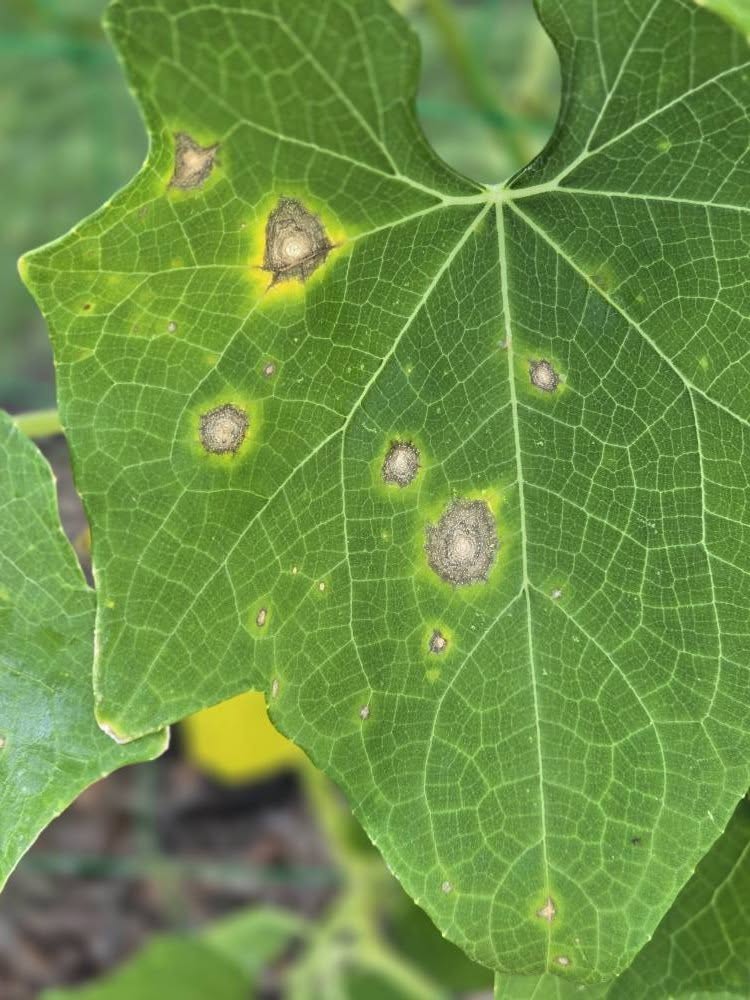
Alternaria Leaf Spot. Early stage.
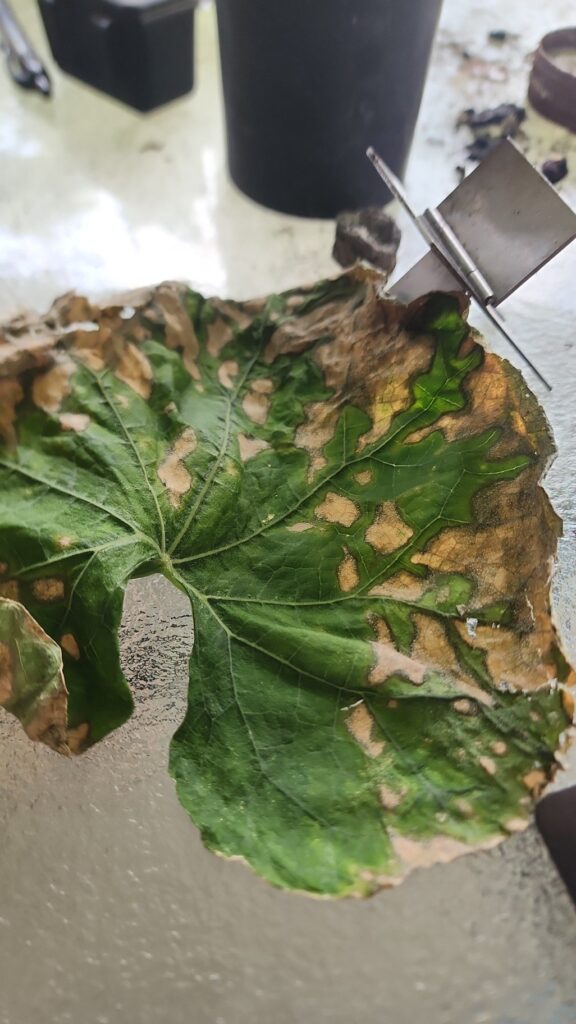
Advanced alternaria leaf blight. Soon, the entire leaf will become brown.


Recent Posts

Vineguard: Protection From Sun, Rain, and Frost.

  Here’s an idea. Design an arched trellis structure to protect mirlitons from excessive rain, solar radiation, and cold. I call it a Vineguard. It can be used to shunt rain away from the beds, shield the vine from intense heat, and protect it from frost. ...

How to Prune Back a Mirliton in a Container

Although we recommend trellising mirliton vines while they are in 3-gallon containers, some people prefer to prune them back. Pruning is safe and will result in a compact, bushy plant.   The most important point is that when you prune, leave at least three plant...

Lightweight Frost Protection: The Glore System

Growing mirlitons can be physically challenging for people like me, who have health or age problems that limit our ability to get around. Putting up frost protection can be a real headache.   Michelle Impastato Glore invented a solution: She uses lightweight...

Buyer Beware! How to Sell and Buy Mirliton Seeds, Sprouts, and Plants

  The Mirliton.Org Facebook group serves as a market for people to sell or gift mirliton seeds and sprouts. We want to ensure that only viable seeds are transferred so that people are guaranteed a successful growing experience. We don’t want to mandate standards...

How to Rescue a Raised Bed From a Flood

Noah couldn’t do it, nor can we, but Michelle Impastato Glore invented a brilliant idea: use a raised bed with a moisture barrier to overcome a saturated yard. The Outcome: She planted a new mirliton in September in the raised bed in her water-saturated yard, and four...

How Mirliton Sprouts Root When Containerized

 The photo shows that although the root radicles (white, bumpy protuberances at the top) are pointing upward, yet the roots themselves have begun to grow downward into the soil. The radicle is the embryonic root of the plant, and in this case, even though it was...

Using a Bamboo Stake to Measure Soil Moisture

An old tomato stake can be used to measure soil moisture and prevent waterlogging. We generally recommend using a metal soil sampler, but the bamboo stake will work in a pinch.  Click on each photo in this link to read the instructions about how to use it. Click...

Buyer Beware!

  It’s that time of the year when desperate gardeners in search of an Heirloom Mirliton see one at a garden store and snatch it up. But garden stores are notorious for selling mirliton plants without naming the variety or grower. They may well be an authentic...

Search Before You Post! (For those looking for Heirloom Mirlitons)

FOR THOSE LOOKING FOR HEIRLOOM MIRLITONS: PLEASE READ BEFORE POSTING By David Hubbell Currently we are receiving excessive requests for “searching for” or “anybody have any” heirloom mirlitons in _____, Louisiana/Mississippi/Alabama posts. From our past history with...

How to Get a Crop Next Spring With the Mirliton Sprout You Have Now.

  How can you get a spring harvest from a newly planted mirliton? Try a little Wizardry--trick the sprout! We learned last year that people who plant fall sprouts in containers can get a crop as early as the next spring. How did they do that? They made the sprout...