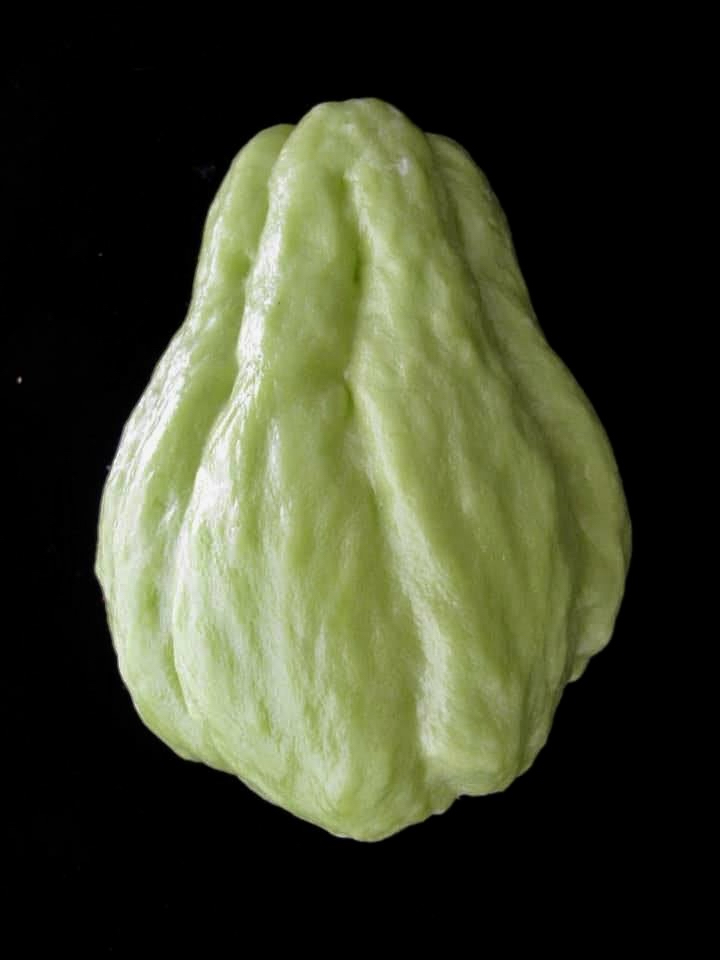
Mirliton is the name people gave the chayote (Sechuim edule) when it first arrived in Louisiana. Chayote is the main species, and there are many subspecies (subvarieties) worldwide with different names. They are what botanists call a “landrace.” Landraces are open-pollinated domesticated plants that have developed over time, adapted to their natural environments, and are not the product of human manipulation, such as plant breeding or modern genetic science. Haitians brought the first mirlitons to Louisiana over two centuries ago, and that landrace thrived because it was adapted to our altitude, climate, pests, and diseases.
Since the Louisiana variety has never been analyzed genetically, we have had to classify it and its subvarieties based on fruit appearance. The Louisiana mirliton landrace has distinctive fruit traits (morphology); they are large, slightly pear or egg-shaped, with smooth skin, longitudinal furrows (though a few may be unfurrowed), and either green or white. Over the years, other varieties were probably introduced from Mexico and Central America and interbred with the Louisiana landrace. The resulting landrace was what generations of Louisianians simply called “mirlitons.” And for most of the last two centuries, there was only one variety.
Then things changed. Hurricane Katrina wiped out almost all the mirlitons in New Orleans, so I began searching for growers of our Louisiana landrace to replace them. I eventually found many growers in rural areas, and when I did, I would name the mirliton after the grower so that we could track and preserve it.
I soon noticed differences within Louisiana mirlitons — there were clearly distinct subvarieties within the landrace. Mirlitons were more complex than we thought. I decided to classify the subvarieties by fruit morphology and then interview the growers to determine the strain’s history. If it were a unique variety, we would name the variety so we could track and preserve it. That’s how “named varieties” came to be.
In 2024, we have reached the point where we have identified most of the Louisiana subspecies. To simplify matters, from this point forward, we will classify mirlitons into two categories:
- Certified Heirloom Mirlitons: These are the common Louisiana mirlitons and make up the majority of our landrace that has grown here for decades. They are largely indistinguishable from each other. They have been submitted to Mirliton.Org for certification, and after review, Mirliton.Org determined they met all the visual criteria for heirlooms. If we certify it, you can say that you are growing a “certified mirliton” or “certified heirloom.” If someone asks you the name, just say it’s an unnamed variety. (If you are growing a mirliton of unknown origin, you can submit for certification at lance@mirliton.org)
- Certified Named Heirloom Mirlitons: These are the unique subvarietiies ot the Louisiana landrace that we named so we can track and preserve them. Like the Ishreal Thibodeaux mirliton, they are morphologically unique enough that we can visually recognize them. When growers say they are a Papa Sylvest or a Dupuy-Prejean, it means that Mirliton.Org has certified them as a unique subvariety.
Certified Named Louisiana Heirloom Mirliton Varieties:
Ervin Crawford
Ishreal Thibodeaux
Boudreaux-Robert
Papa Sylvest
Bogalusa whites
Chauvin-Rister
Miss Clara
Remondet-Perque
Joseph Boudreaux
Bebe Leblanc
Maurin
Jody Coyne
Dupuy-Prejean
Certified Louisiana Heirloom Mirlitons:
Here is an updated list of people who have submitted photographs of mirlitons they are growing for certification as part of the Louisiana Heirloom Mirliton landrace. We have examined them, and the fruit matches all the characteristics (morphology) of the traditional Louisiana Heirloom Mirliton landrace. Accordingly, we have determined that they are the Certified Louisiana Heirloom Mirliton variety. The owners are entitled to refer to them as “Certified Mirlitons.”
(photographs and date submitted are on file)
Why We Track Heirloom Varieties:
Why is it important to continue tracking heirlooms? Beginning in 2020, several large grocery store chains began importing chayote (mirlitons) that looked exactly like our heirloom varieties. People began buying them, using them as seeds, and growing mirlitons indistinguishable from our heirloom varieties. The problem is that imported chayote may carry a seed-transmissible virus that can destroy our heirlooms. It’s called Chayote Mosaic Virus (ChMv), which devastated crops in other countries. Recent research has also discovered new strains of anthracnose in Brazilian chayote that can be transmitted inside the fruit.
We created the certification process to help preserve and popularize the Louisiana heirloom variety. We recommend that the best way to accomplish this is to use only certified heirloom seeds.