Anthracnose

by | Jul 8, 2022 | Mirliton | 0 comments

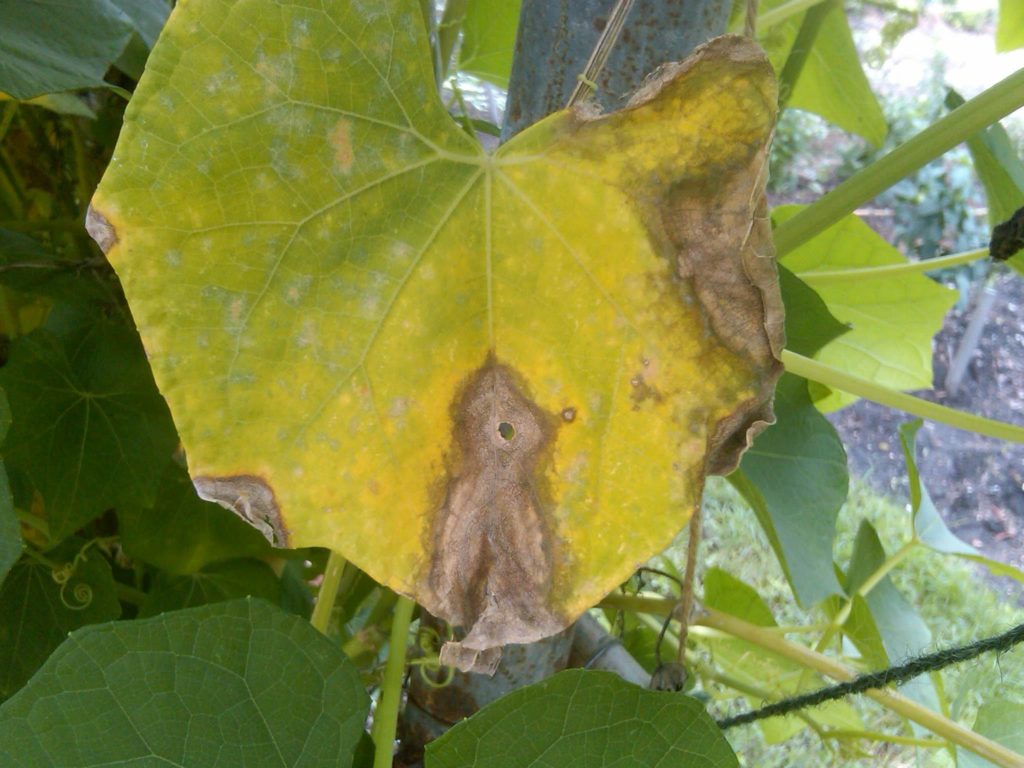
Mirliton leaf infected with anthracnose. Unlike powdery mildew which yellows uniformly and wilts the leaves, anthracnose starts as yellow wedges between the leaf veins. It then turns the leaf tissue brown and leaves a distinctive “shot hole” in the middle of the brown patches. This is because the anthracnose fungus feeds on both living and dead tissue.

Seasons change and diseases change.  For mirlitons (chayote), the cooler, drier spring is time for the airborne mildews (powdery and downy), but the hot rainy months July through August—bring anthracnose season.  Being prepared for it can significantly reduce the damage the disease might do. 

First, know the enemy.  The above photo provides all the classic signs of anthracnose; a yellow wedge that turns into dead paper-like tissue, with a shot-hole in the middle. If you got these, you got anthracnose.

Anthracnose is a disease caused by the fungus Colletotrichum lagenarium in mirlitons. There are many fungi that cause anthracnose disease, but for our purposes, we’ll call Colletotrichum lagenarium the “anthracnose fungus.”  Unlike mildews which are carried by air, the anthracnose fungus is waterborne. That means it is carried by water droplets, splashing up from the soil and then from leaf to leaf. That’s important because it means that while you might be able to wash off some fungi with a good shower from your hose, the same shower will splash anthracnose fungus all over your vine and cause a massive anthracnose infection. 

Three Steps to Manage Anthracnose:

  1. Don’t give your vine showers.  Water from at the bottom of the vine with a hose set on low or drip irrigation.
  2. Don’t drown the vine. Too much soil moisture stresses mirliton and makes it difficult for it to fight fungi. Make sure your raised beds and ground plantings have adequate drainage, if they don’t have it, then add it now.
  3. Don’t worry; Be Happy. As horrible as anthracnose looks, infected vines normally recover in September and flower and fruit. Plus, they acquire increased resistance to the disease.


Here’s a more complete fact sheet on anthracnose and how to protect your plant by prepping your planting site or raised bed::Here

Recent Posts

Vineguard: Protection From Sun, Rain, and Frost.

  Here’s an idea. Design an arched trellis structure to protect mirlitons from excessive rain, solar radiation, and cold. I call it a Vineguard. It can be used to shunt rain away from the beds, shield the vine from intense heat, and protect it from frost. ...

How to Prune Back a Mirliton in a Container

Although we recommend trellising mirliton vines while they are in 3-gallon containers, some people prefer to prune them back. Pruning is safe and will result in a compact, bushy plant.   The most important point is that when you prune, leave at least three plant...

Lightweight Frost Protection: The Glore System

Growing mirlitons can be physically challenging for people like me, who have health or age problems that limit our ability to get around. Putting up frost protection can be a real headache.   Michelle Impastato Glore invented a solution: She uses lightweight...

Buyer Beware! How to Sell and Buy Mirliton Seeds, Sprouts, and Plants

  The Mirliton.Org Facebook group serves as a market for people to sell or gift mirliton seeds and sprouts. We want to ensure that only viable seeds are transferred so that people are guaranteed a successful growing experience. We don’t want to mandate standards...

How to Rescue a Raised Bed From a Flood

Noah couldn’t do it, nor can we, but Michelle Impastato Glore invented a brilliant idea: use a raised bed with a moisture barrier to overcome a saturated yard. The Outcome: She planted a new mirliton in September in the raised bed in her water-saturated yard, and four...

How Mirliton Sprouts Root When Containerized

 The photo shows that although the root radicles (white, bumpy protuberances at the top) are pointing upward, yet the roots themselves have begun to grow downward into the soil. The radicle is the embryonic root of the plant, and in this case, even though it was...

Using a Bamboo Stake to Measure Soil Moisture

An old tomato stake can be used to measure soil moisture and prevent waterlogging. We generally recommend using a metal soil sampler, but the bamboo stake will work in a pinch.  Click on each photo in this link to read the instructions about how to use it. Click...

Buyer Beware!

  It’s that time of the year when desperate gardeners in search of an Heirloom Mirliton see one at a garden store and snatch it up. But garden stores are notorious for selling mirliton plants without naming the variety or grower. They may well be an authentic...

Search Before You Post! (For those looking for Heirloom Mirlitons)

FOR THOSE LOOKING FOR HEIRLOOM MIRLITONS: PLEASE READ BEFORE POSTING By David Hubbell Currently we are receiving excessive requests for “searching for” or “anybody have any” heirloom mirlitons in _____, Louisiana/Mississippi/Alabama posts. From our past history with...

How to Get a Crop Next Spring With the Mirliton Sprout You Have Now.

  How can you get a spring harvest from a newly planted mirliton? Try a little Wizardry--trick the sprout! We learned last year that people who plant fall sprouts in containers can get a crop as early as the next spring. How did they do that? They made the sprout...