How to Rescue a Raised Bed From a Flood

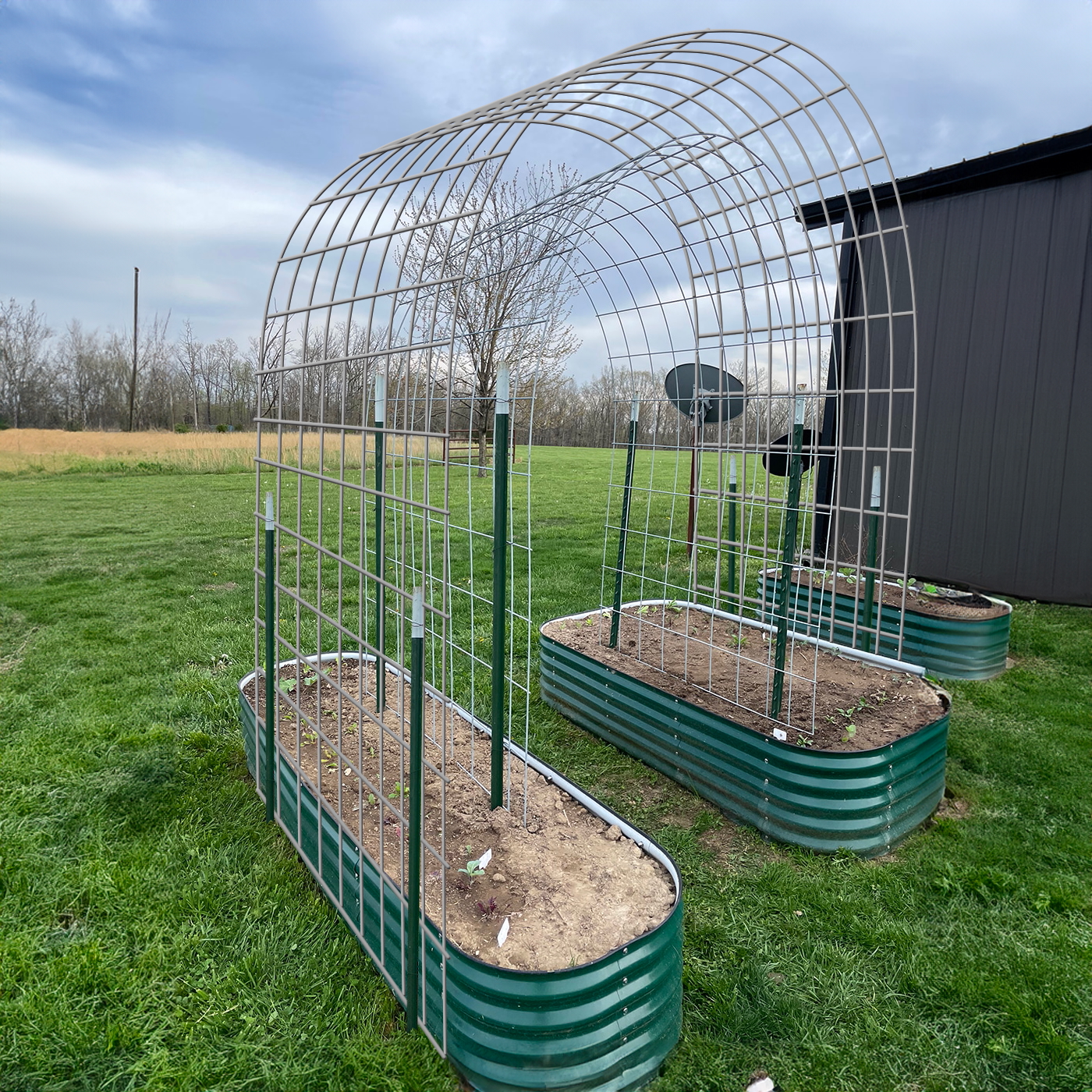
Michelle Glore’s raised bed with a silver plastic moisture barrier beneath it.

Noah couldn’t do it, nor can we, but Michelle Impastato Glore invented a brilliant idea: use a raised bed with a moisture barrier to overcome a saturated yard.

The Outcome: She planted a new mirliton in September in the raised bed in her water-saturated yard, and four months later, in December, she harvested mirlitons!

The problem with raised beds is that when the soil beneath them becomes saturated, the bed won’t drain. It’s a scientific principle that fluids will always flow from an area of higher pressure to an area of lower pressure until equilibrium is reached. That means that when the garden soil is flooded, the moisture in the raised bed won’t flow downward.

In the past, we recommended drilling holes in the raised bed above the soil line to allow moisture to flow laterally. That works, but Michelle installed a plastic barrier under the raised bed, which accomplishes two things. (1) It prevents ground moisture from leaching upward into the bed when the yard is saturated, and (2) it allows excess bed moisture to flow out through the cracks at the base, where there is no pressure.

If your tall raised bed has horizontal holes and a plastic moisture barrier beneath, it creates two outlets for bed moisture to escape: the horizontal holes and the crack at the base of the bed. The moisture will drain more rapidly, stabilizing soil moisture, which is ideal for mirlitons.

Moreover, the bed does not constantly leech up ground moisture.

If you already have a raised bed, consider switching to a plastic moisture bed now, before you plant. All you have to do is temporarily remove the soil from the bed, install the plastic beneath the bed structure, and then refill the bed. Make sure the plastic extends beyond the bottom edges of the bed structure. If you don’t already have them, drill a few holes in the bed, a few inches from the base, for lateral drainage. 

Here’s a video of Michelle’s moisture-protected raised bed and the vine she planted in September that produced only four months later.

How Mirliton Sprouts Root When Containerized

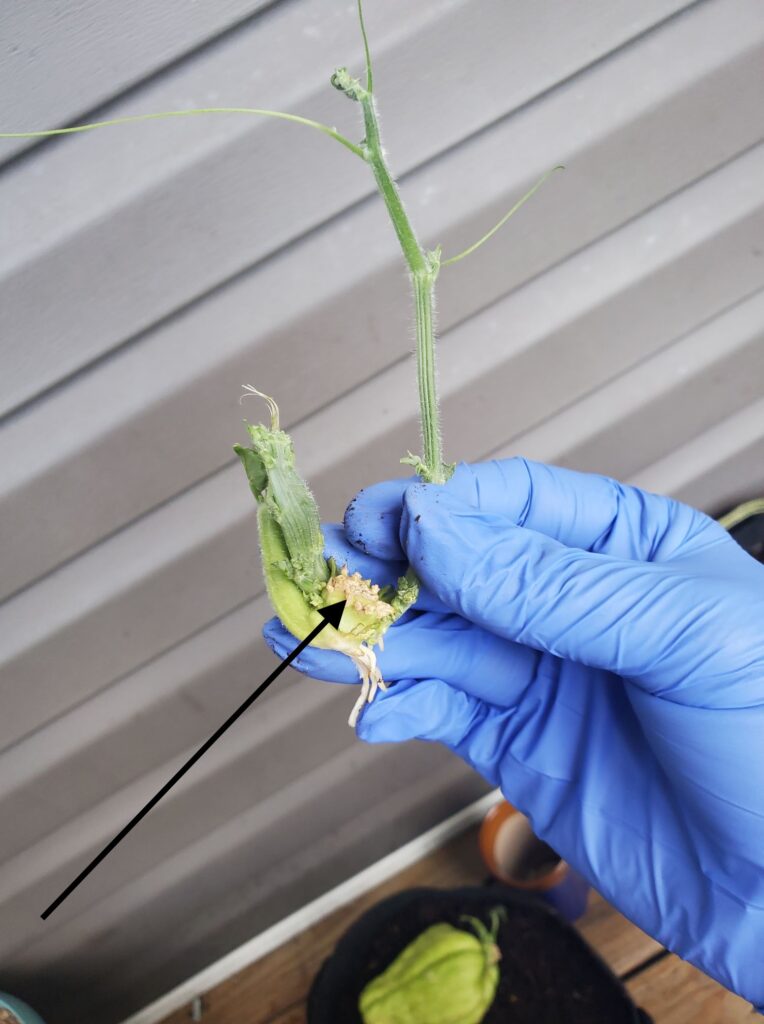
Young mirliton sprout removed from the container. The arrow points to the plant radicle (rooting organ)

 The photo shows that although the root radicles (white, bumpy protuberances at the top) are pointing upward, yet the roots themselves have begun to grow downward into the soil. The radicle is the embryonic root of the plant, and in this case, even though it was planted mostly above the soil line, it immediately sent roots downward to absorb water and nutrients from the soil. So even if you plant the seed upside down, the roots know which way to grow. That’s why mirliton sprouts generally succeed, regardless of whether they are planted “large end up” or “large end down.”

Buyer Beware!

Buyer Beware!


It’s that time of the year when desperate gardeners in search of an Heirloom Mirliton see one at a garden store and snatch it up. But garden stores are notorious for selling mirliton plants without naming the variety or grower. They may well be an authentic Louisiana heirloom variety, but if you buy from a garden store, eBay, or Facebook Marketplace, you are taking a risk. That’s why we advise people to only purchase seed and plants from members of this group because we verify that they are selling authentic, certified heirlooms. 

But, if you buy from a garden center, we recommend checking the plant label to confirm it is a named Certified Louisiana Heirloom Variety. All the named varieties are in the post below.  If the label says it’s an “unnamed variety”, ask the store owner who sold them the seed. You will also find a list of all the people growing and selling unnamed varieties in the post. If it has no label and the store owner won’t tell you where they got it, turn around and go home.

We are the only organization in the U.S. that certifies heirloom mirlitons, and we do so to ensure people receive a variety that grows well in our region. 

See the list of named varieties and the list of people selling unnamed varieties here.

Search Before You Post! (For those looking for Heirloom Mirlitons)

FOR THOSE LOOKING FOR HEIRLOOM MIRLITONS: PLEASE READ BEFORE POSTING

By David Hubbell

Currently we are receiving excessive requests for “searching for” or “anybody have any” heirloom mirlitons in _____, Louisiana/Mississippi/Alabama posts. From our past history with the page, it has been found these posts easily get lost in the shuffle and are not effective.
 
As such we are not approving those posts.
 
We have found the better alternative is to use the “Search” function (magnifying glass icon) to type in terms such as “for sale”, variety name, or a name of a nearby location. At this point you can find a grower close to you and comment on their post and arrange to exchange a direct message.
 
NOTE: most growers aren’t set up to mail sprouts so you have to be willing to drive or arrange for someone to pick up the sprouts or pots. We expect sprouts to be available from various growers soon and potted vines in January.
 
Thank you for your understanding and cooperation.

If You Overwinter Sprouts in a 3-Gallon Container In the Fall, You’ll Get Spring Crop!

Mirlitons are being overwintered in 3-gallon containers.

How can you get a spring harvest from a newly planted mirliton?

Try a little Wizardry–trick the sprout!

We learned last year that people who plant fall sprouts in containers can get a crop as early as the next spring. How did they do that? They made the sprout think it had been planted in the ground for several months. 

Here’s how it works:

The reproduction clock on a mirliton starts the day it senses that it’s in soil. Then it will flower and fruit 110 days later. 

Do the math.

If you container-plant a sprout in November and then transplant it into the ground in March, it has been in soil for 110 days by the following May. That’s why so many people who container-planted their fall sprouts last year got a small spring crop. 

That won’t happen if you use the old method of overwintering your sprouts in paper bags underneath your sink. No soil, no reproductive clock.

An academic scientist did not discover this trick. Mirliton growers discovered it.

Congratulations!

Normally, newly planted mirlitons don’t flower and fruit until the following fall. But if you overwinter them in a container, they will develop a strong rootball, helping them thrive once transplanted.

So, plant that sprout in a 3-gallon plastic or cloth container now and get ready for a spring crop as well as one next fall!


The Myth that Spraying Your Mirliton (Chayote) With Sugar Water Will Attract Pollinators

Ants over the mirliton flower

There’s a popular myth going around that spraying sugar water on your mirliton vines will attract pollinators.  Not only won’t sugar water attract pollinators, but it may also damage your vine.

The main pollinators for mirlitons are bees and wasps.  Sugar mainly attracts ants, not bees, and ants are poor pollinators for mirlitons. Here’s why:

  • Physical characteristics: Unlike bees, ants have smooth bodies that don’t retain and transfer pollen as well as bees.
  • Chemical defenses: Many ant species secrete a natural antibiotic on their bodies to protect against bacteria and fungi. This substance can also destroy pollen grains, making successful pollination less likely.
  • Nectar robbing: Ants often act as nectar robbers, consuming nectar from the flowers without effectively transferring pollen from the male to the female flower’s reproductive parts.

Moreover, spraying sugar water on mirliton vines can actually damage them by promoting mold and bacterial growth.

If you don’t see bees and wasps, which are effective pollinators, hand-pollinate instead of spraying sugar water on it

Here’s an academic article on chayote (mirliton) pollinators in Mexico

Frost Protection: Extend Your Harvest Through December.

Extend Your Harvest Season: Protect Your Mirliton Vine on Frost Nights.

The old tradition of cutting back your mirliton vine in November was based on old weather patterns. The weather is changing, and we need to change with it.  Intensive summer rains,  fall heatwaves, and droughts have delayed flowering and fruiting. As soon as the vines start to fruit,  a frost comes along and wipes out the vine. You don’t have to let that happen.  With a little preparation, you can beat the frost and harvest fruit all the way through December. 

In horticulture, this is known as extending the season, which involves using techniques to prolong the growing season beyond its natural limits. In 2024, several people used tenting and heating methods that allowed vines to produce fruit all the way through December. 

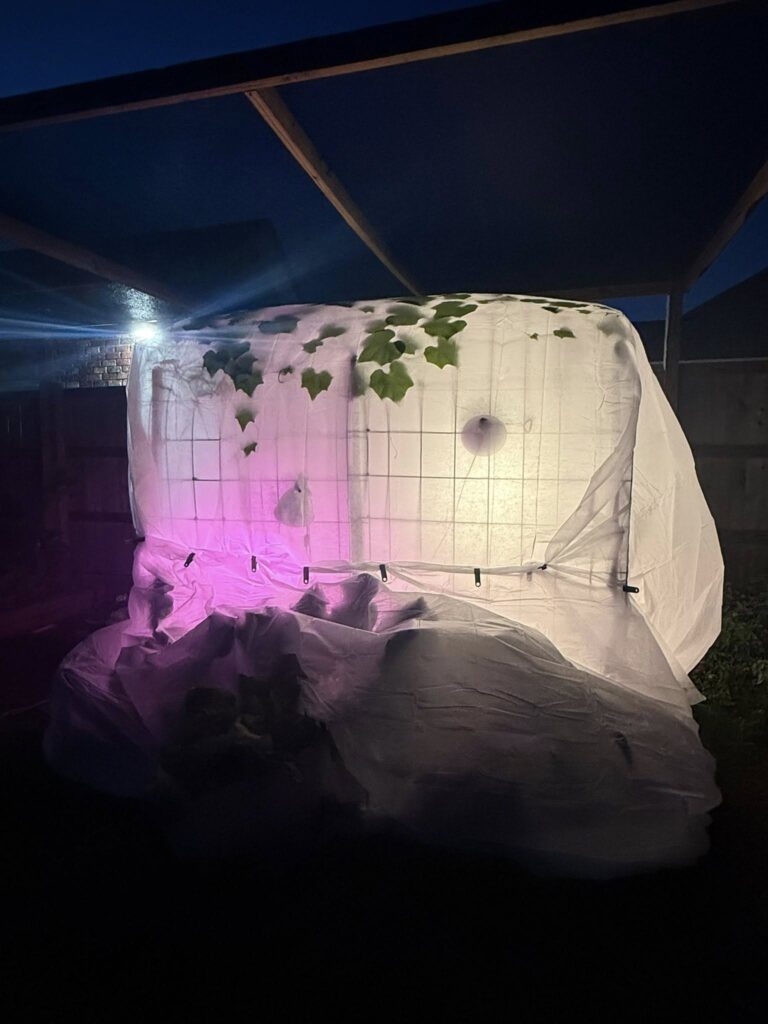
All that it takes to protect your vine from an early frost is to temporarily tent your vine with a FEMA tarp or a clear plastic sheet. Secure the bottom of the cover with weights to trap the ground heat and prevent the cover from blowing off. That will trap enough ground heat to prevent most frost damage.

If you use a tarp, you will need to take it down the next day when the temperature warms up–the vine needs sunlight. Clear plastic is much better because you can leave it up for a day or two, but loosen the bottom so that airflow is maintained and the vine doesn’t overheat. Keep the ground below the vine clear of debris and moist to enable the soil to absorb daytime heat, which will radiate into the tent at night.

This tenting technique requires some extra effort — watching the weather forecast and putting up and taking down the cover — but it will extend the harvest season by several weeks.

We can get a damaging frost anytime the temperature is forecast to fall below 42°. So use that as a sign to cover the vine.

Tarps and 6-mil plastic will trap enough ground heat to protect a vine from frost at temperatures in the low 30s. Make sure you seal the bottom with bricks to keep the wind out and the heat in. If you add a small space heater on nights, it will protect the vine at temperatures below 32 degrees, and you can probably harvest fruit in January–and have a vine with a full canopy ready for a spring harvest.

Here are the tools to use to extend the growing season. Buy them now so you will be prepared:

6-mil plastic sheeting
Portable Heater (electric, propane, or heat lamp)

A  remote thermometer is not absolutely necessary, but it can be useful for monitoring the temperature inside the tent. 


Deb Sepulveda’s tented vine


Nancy Wolfe’s camping tent enclosure.

Paige Dyer’s 6-mil plastic tent.

Lee Segrura’s tented vine with pipe frame.

Melissa Minevielle’s tented vine with heater.

Walter Livaudais’s tarp frost cover.

John Dauzat’s Tent of pipe frame. He encloses the entire vine and heats it.


The Fall Equinox Triggers Flowering in Mirlitons (September 21-24)

The Fall Equinox Triggers Flowering in Mirlitons

Mirlitons are a photoperiodic plant that flowers in response to the day length. They have photoreceptors in their leaf cells that detect changes in light and day length. When daylight hours become less than 12 hours, they tell the plant to initiate flowering. That happens at the fall equinox, which occurs yearly between September 21 and September 24. 

There’s considerable variation–flowering can come a few weeks before or a few after the equinox. And it may depend on the latitude you live at; flowering may start later the further north you live.

Mirlitons are also thermoperiodic, meaning that an abrupt cold spell will also nudge them to flower.

The Spring equinox,  which occurs between March 20 and 23, will trigger flowering in the spring.


It’s a Dead Heat: How Heat Stress Kills Mirliton Vines and What You Can Do to Prevent It


We have a problem.

The 2023 heat dome killed almost every mirliton vine in Louisiana. Then the  2024 heat waves nearly wiped out most first-year vines. How does heat stress cause mirlitons to fail, and what can we do about it?

What is Heat stress?

The term “heat stress” refers to a period in which plants are subjected to high temperatures for long enough to permanently alter their ability to function or grow normally. Heat stress is the cumulative effect of the heat’s severity, the time the plant is exposed to the heat, and the rate at which the temperature is rising.

What is a Heat Wave?

It depends on where you are.  Obviously, a warm day in Louisiana might be a blistering heatwave in Vermont.  Generally, botanists define a heat wave as any period when temperatures exceed 90℉ for 7-10 days. That’s a national average, of course. Along the Gulf Coast, we can reasonably say that several consecutive days exceeding 93° will stress a mirliton vine and require protective measures. 

High temperatures and high heat index are not the same thing. The heat index combines temperature and humidity–but plants can’t feel humidity, nor does it affect them. They only feel the temperature of the surrounding atmosphere. If you place a thermometer next to a leaf, it will tell you precisely the heat that the plant is experiencing. 

For our purposes, only the ambient temperature measured with a thermometer determines whether a heat wave is present.

Heat Stress and the Mirliton Canopy

Solar radiation is both life-giving and life-taking for a plant. It’s what fuels photosynthesis that enables plant growth, but it can also damage a plant and cause plant failure.

 Solar radiation is the source of all heat stress. It is comprised of infrared rays (IR), which heat up plants when they strike the leaves, and ultraviolet-b (UVB), which regulates plant growth and development. While they both are essential to plant life, excessive IR and UVB can damage a mirliton and cause plant failure. 

We tend to think that a heatwave simply dehydrates a plant–like it does humans. It’s not that simple;  excessive heat from the sun sets off a cascade of problems. It does this in three ways.

First, excessive UVB can literally kill the plant’s chloroplasts in the leaves.  Chloroplasts are essential in the photosynthesis process of turning sunlight into sugars to nourish plant life. Without chloroplasts, the plant is starved of a fundamental nutrient. Interestingly, the main reason imported chayote don’t grow well in the U.S.A. is that they are grown at high altitudes on cloud-covered mountains in Mexico and Central America. The clouds filter out significant UVB. Take the same variety and plant it in the U.S.A., and it will get a full dose of UVB and die. 

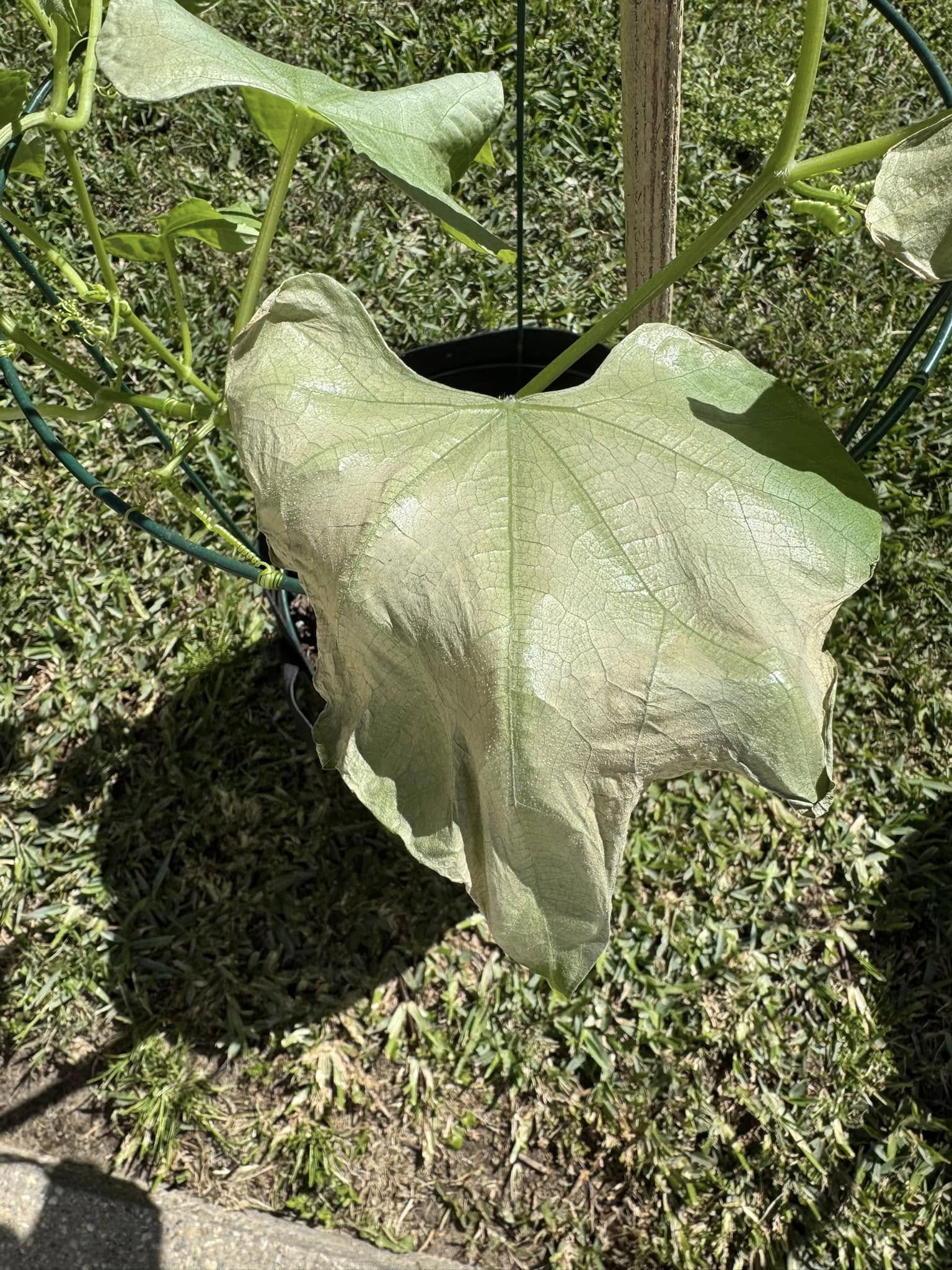
Second, excessive solar radiation can overheat a plant and induce a type of heat stroke.  Stomata are tiny pores on leaves that guard plants against excessive heat by regulating leaf temperature with evaporative cooling. When temperatures rise, stomata open wider, releasing water vapor into the atmosphere. This process, called transpiration in plants, cools the plant and leaf surface, similar to how sweating cools the human body. But too much heat causes the stomata to close, and the plant loses its ability to cool itself.  The plant overheats and dies from excessive heat. 

Third, when the stomata in the leaves are open, they facilitate a flow of dissolved nutrients from the soil upward to the leaves, thereby nourishing the entire plant. The stomata accomplish this by releasing water vapor from the leaves, which creates a negative pressure, or “pull,” that draws water up from the roots through the plant’s xylem via the transpiration process. This transpiration-driven water movement creates a continuous column of water from the soil, up the roots, and out into the atmosphere. 


The open stomata are key to pulling a continuous column of water from the soil, up the roots, and out into the atmosphere. But, too much heat and the plant closes the stomata, which then prevents the plant from not only regulating leaf temperature and taking in CO2 for photosynthesis. Plant temperature soars, nutrients cease to flow, and the plant fails. That means that during a heat wave, no matter how much you water your mirliton vine, the heat may close the stomata, the plant’s temperature will rise, and the plant will fail. 

Heat stress also affects the plant’s metabolic processes, causing oxidative stress, which harms cells and impairs growth; gibberellic acids and other phytohormones go awry, causing buds, blossoms, and fruit to drop off. 

Bottom line: Heat stress can simultaneously overheat, starve, and trigger a cascade of events that can kill your mirliton vine.

How Can We Protect the Canopy?

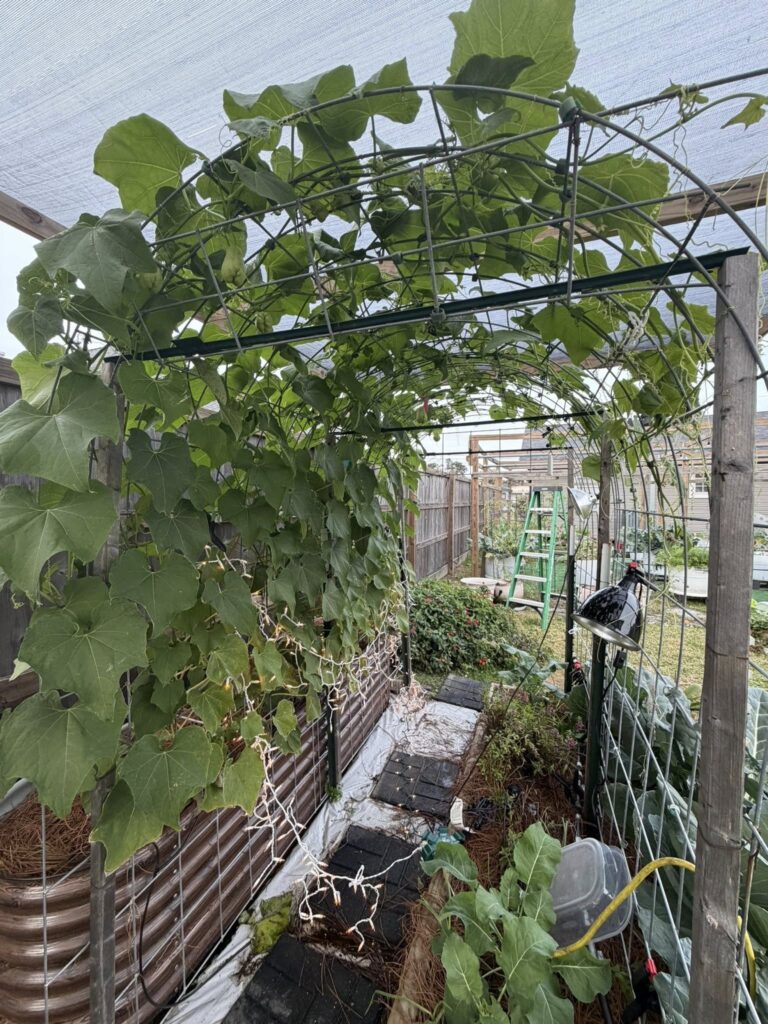
We’ve already found the solution: shade cloths. We are fortunate that most mirliton growers use small trellises that can easily and affordably be covered with a 40% shade cloth. Those will filter out substantial UVB, which will protect the chloroplasts, and the infrared rays that will cool the plant. (Don’t use denser shade cloths, as the vine does need solar radiation to grow, and UVB is a natural fungicide.) 

Growers who have trellis structures for shade cloths don’t have to worry about heat waves. 

Moreover, a shade cloth structure can also serve as protection from excessive rain. That’s particularly important following the 2025 monsoon rains that waterlogged and killed most first-year vines. Your shade cloth frame can double as a “rain-guard” when needed. You can simply drape a sheet of 6-mil plastic over the shade frame of cloth to shunt the rain off to the sides of the bed like an umbrella.  

Come hell or high water, you’ll be covered.


Root-Knot Nematodes in Mirlitons

Root-Knot Nematodes Galls on Parasitized roots.

If your mirliton vine begins to come back each year with less vigorous growth and fruit yield, root-knot nematodes (RKN) may explain the cause. They are especially a problem with older vines in sandy soil. In Mexico and Central America, RKN are such a pest that the large commercial chayote farms pull up all their plants every three years and replace them with new ones.

RKN can infest the roots of mirliton within three years, though we don’t normally see that problem in the Gulf Coast south.  Nematodes are deceptive and hard to diagnose without digging up the roots and inspecting them for galls.  RKN don’t suddenly kill mirlitons vines; instead, they gradually drain them of nutrients so that the most frequent symptom is little growth and low fruit yield.

When the vine begins to exhibit this slow decline, most growers often think it is due to a lack of fertilizer and try to solve the problem by piling on more fertilizer. 

But the solution is simple. You can buy beneficial nematodes that kill the root-knot ones. You add the beneficial nematodes to a gallon of water and drench the soil in the early spring and late fall. That will wipe out the root-knot nematodes almost immediately, and will continue to contriol them if treated every three years.

You can buy them here.

View photos of the excavated roots here.


Recent Posts

How to Rescue a Raised Bed From a Flood

Noah couldn’t do it, nor can we, but Michelle Impastato Glore invented a brilliant idea: use a raised bed with a moisture barrier to overcome a saturated yard. The Outcome: She planted a new mirliton in September in the raised bed in her water-saturated yard, and four...

How Mirliton Sprouts Root When Containerized

 The photo shows that although the root radicles (white, bumpy protuberances at the top) are pointing upward, yet the roots themselves have begun to grow downward into the soil. The radicle is the embryonic root of the plant, and in this case, even though it was...

Buyer Beware!

  It’s that time of the year when desperate gardeners in search of an Heirloom Mirliton see one at a garden store and snatch it up. But garden stores are notorious for selling mirliton plants without naming the variety or grower. They may well be an authentic...

Search Before You Post! (For those looking for Heirloom Mirlitons)

FOR THOSE LOOKING FOR HEIRLOOM MIRLITONS: PLEASE READ BEFORE POSTING By David Hubbell Currently we are receiving excessive requests for “searching for” or “anybody have any” heirloom mirlitons in _____, Louisiana/Mississippi/Alabama posts. From our past history with...

Frost Protection: Extend Your Harvest Through December.

Extend Your Harvest Season: Protect Your Mirliton Vine on Frost Nights. The old tradition of cutting back your mirliton vine in November was based on old weather patterns. The weather is changing, and we need to change with it.  Intensive summer rains,  fall...

The Fall Equinox Triggers Flowering in Mirlitons (September 21-24)

The Fall Equinox Triggers Flowering in Mirlitons Mirlitons are a photoperiodic plant that flowers in response to the day length. They have photoreceptors in their leaf cells that detect changes in light and day length. When daylight hours become less than 12 hours,...

Root-Knot Nematodes in Mirlitons

If your mirliton vine begins to come back each year with less vigorous growth and fruit yield, root-knot nematodes (RKN) may explain the cause. They are especially a problem with older vines in sandy soil. In Mexico and Central America, RKN are such a pest that the...