Deep Roots

by | Jul 12, 2022 | Mirliton | 0 comments

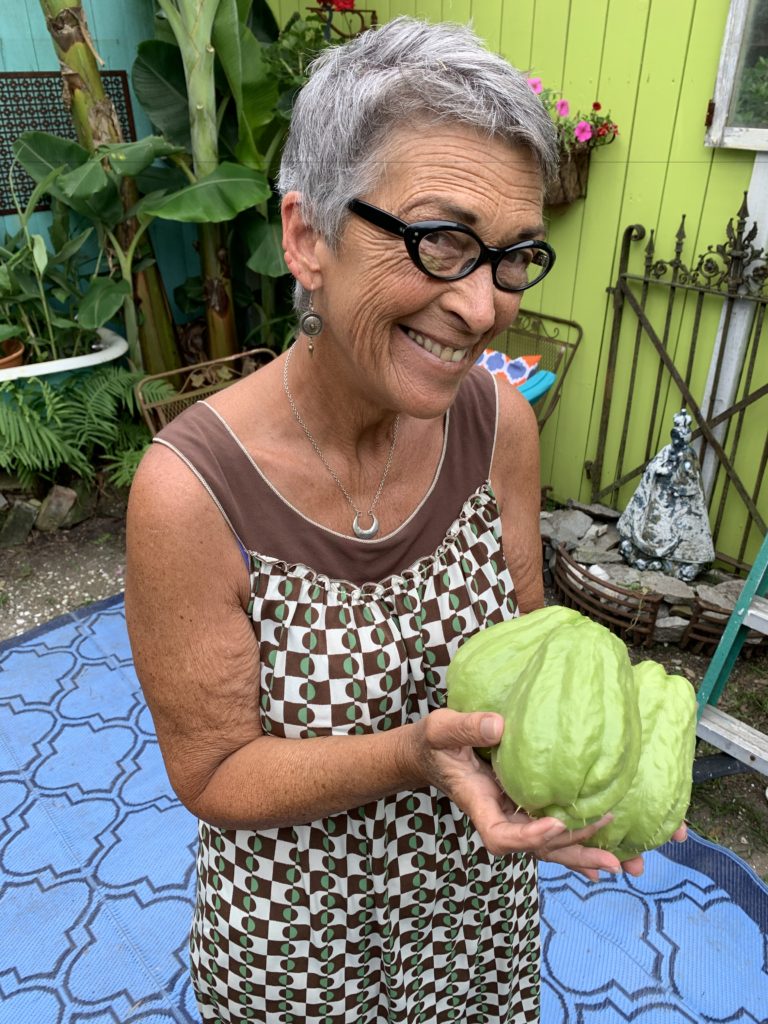
Debra Voelker (photo by Renee Lapeyrolerie)

By Renee Lapeyrolerie

Debra Voelker is Jazz Fest, Mardi Gras, costumes, and mirliton. She has roots on St. Ann Street and Ursulines Avenue. Her dad grew mirliton on Orleans Avenue and her maw maw stuffed them on Canal Street. About six years ago, Debra got mirliton seed from a friend who’d shared on a social media post that she’d put them ‘out for the taking’ from her front porch. The supplier said that she had gotten seed from an elder whose vine survived Hurricane Katrina’s winds, although we have not been able to verify the source nor the location.

However nice that would be to know, Debra’s vine has produced multiple years and she was even gifted a crop in the Summer of 2021. Surely, a Louisiana heirloom due to its reliable production and physical characteristics. Debra made a sweet mirliton pie and a soup with her bonus crop. It’s the Fall yield though that brings back memories of her mirliton-filled youth. Her maternal grandmother, or maw maw, who lived on Canal Street just two miles from where Debra now lives, stuffed her mirliton mixture back into the shells for baking, some with ground meat and others with shrimp. Debra makes a traditional stuffing and has added mozzarella, an idea she picked up from a friend. Her father’s sister used to cut mirliton up into big chunks and pickle them that way, after all, mirliton was plentiful in the family.

Debra’s dad grew a vine on the hurricane fence of the home she was raised in on Orleans Avenue near North Carrolton Avenue. She remembers the vine growing all along the fence and sometimes over the garage. She has vivid memories of accompanying him up the street to put bags of mirliton on the neighbors’ stoops. “There would be Schwegmann’s bags of them,” she said, “it was wild!” That is a common unit of measure among mirliton growers during the century-long era of a popular supermarket chain in the New Orleans region.

As we swapped stories about caring for our respective vines she lamented, “I don’t remember my dad doing a damn thing to his vine.” But she does remember a time that a mirliton tendril grabbed onto her hair. When Debra retrieved the mirliton from her friend, they were off-the-vine. She had to wait for them to sprout, she potted them, and got the vine going. For two years the vine produced fruit until a jealous dog interrupted progress in year three. She made another raised bed across the backyard and now both vines have produced and are thriving. Like most growers in the path of Hurricane Ida, her vine support was toppled, but she left it in place because she had fruit.

Recent Posts

Vineguard: Protection From Sun, Rain, and Frost.

  Here’s an idea. Design an arched trellis structure to protect mirlitons from excessive rain, solar radiation, and cold. I call it a Vineguard. It can be used to shunt rain away from the beds, shield the vine from intense heat, and protect it from frost. ...

How to Prune Back a Mirliton in a Container

Although we recommend trellising mirliton vines while they are in 3-gallon containers, some people prefer to prune them back. Pruning is safe and will result in a compact, bushy plant.   The most important point is that when you prune, leave at least three plant...

Lightweight Frost Protection: The Glore System

Growing mirlitons can be physically challenging for people like me, who have health or age problems that limit our ability to get around. Putting up frost protection can be a real headache.   Michelle Impastato Glore invented a solution: She uses lightweight...

Buyer Beware! How to Sell and Buy Mirliton Seeds, Sprouts, and Plants

  The Mirliton.Org Facebook group serves as a market for people to sell or gift mirliton seeds and sprouts. We want to ensure that only viable seeds are transferred so that people are guaranteed a successful growing experience. We don’t want to mandate standards...

How to Rescue a Raised Bed From a Flood

Noah couldn’t do it, nor can we, but Michelle Impastato Glore invented a brilliant idea: use a raised bed with a moisture barrier to overcome a saturated yard. The Outcome: She planted a new mirliton in September in the raised bed in her water-saturated yard, and four...

How Mirliton Sprouts Root When Containerized

 The photo shows that although the root radicles (white, bumpy protuberances at the top) are pointing upward, yet the roots themselves have begun to grow downward into the soil. The radicle is the embryonic root of the plant, and in this case, even though it was...

Using a Bamboo Stake to Measure Soil Moisture

An old tomato stake can be used to measure soil moisture and prevent waterlogging. We generally recommend using a metal soil sampler, but the bamboo stake will work in a pinch.  Click on each photo in this link to read the instructions about how to use it. Click...

Buyer Beware!

  It’s that time of the year when desperate gardeners in search of an Heirloom Mirliton see one at a garden store and snatch it up. But garden stores are notorious for selling mirliton plants without naming the variety or grower. They may well be an authentic...

Search Before You Post! (For those looking for Heirloom Mirlitons)

FOR THOSE LOOKING FOR HEIRLOOM MIRLITONS: PLEASE READ BEFORE POSTING By David Hubbell Currently we are receiving excessive requests for “searching for” or “anybody have any” heirloom mirlitons in _____, Louisiana/Mississippi/Alabama posts. From our past history with...

How to Get a Crop Next Spring With the Mirliton Sprout You Have Now.

  How can you get a spring harvest from a newly planted mirliton? Try a little Wizardry--trick the sprout! We learned last year that people who plant fall sprouts in containers can get a crop as early as the next spring. How did they do that? They made the sprout...